


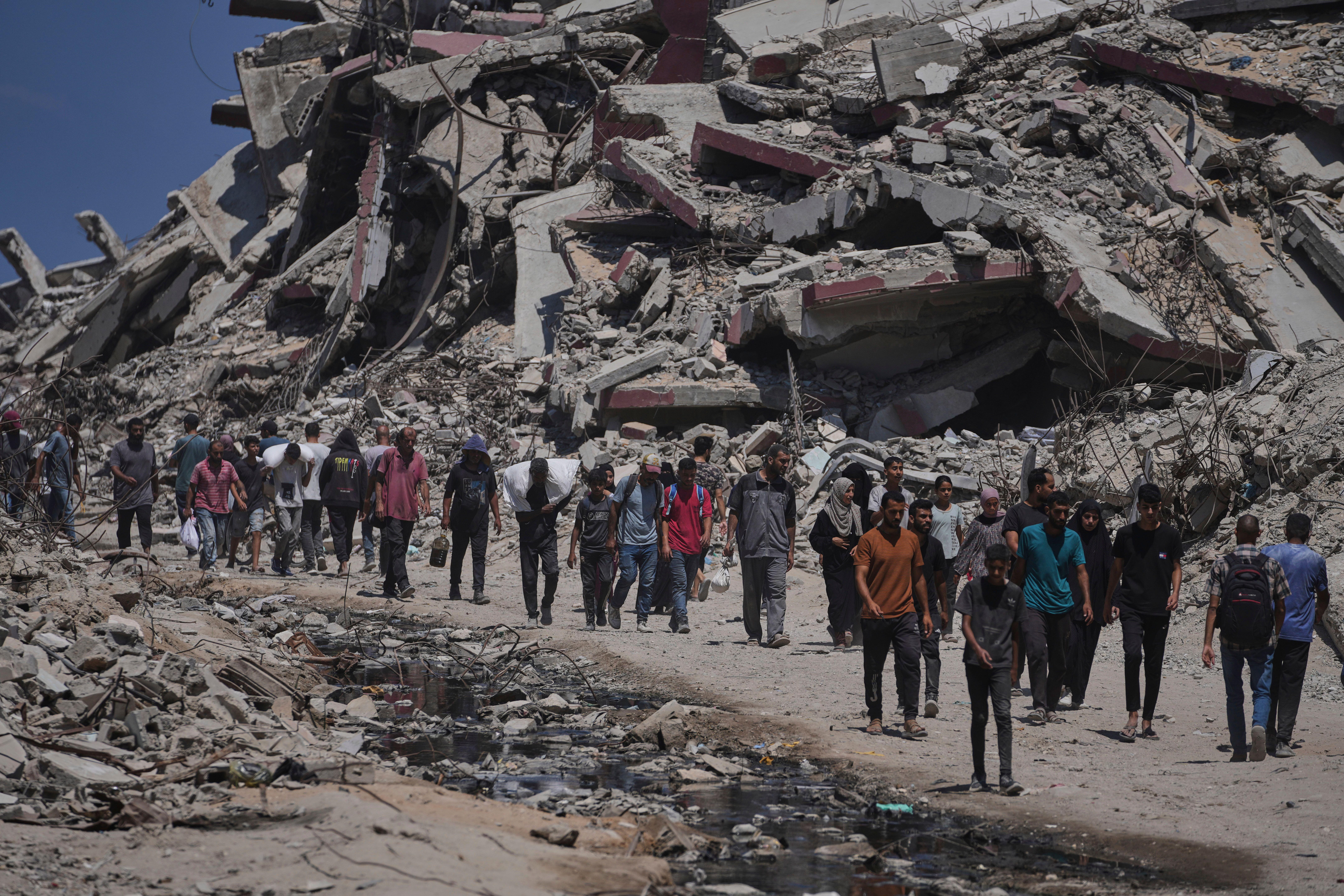
“We come together with a simple, urgent message: the war in Gaza must end now,” said a joint statement released earlier today by the foreign ministers of 25 western countries, Britain included, who warned that “the suffering of civilians in Gaza has reached new depths.”
The demand for an end to the war has already been dismissed by Israel's foreign ministry spokesman Oren Marmorstein who labelled it as “disconnected from reality”, adding that the Israeli government “rejects” it.
The joint statement was signed by the foreign ministers of Australia, Austria, Belgium, Canada, Denmark, Estonia, Finland, France, Iceland, Ireland, Italy, Japan, Latvia, Lithuania, Luxembourg, The Netherlands, New Zealand, Norway, Poland, Portugal, Slovenia, Spain, Sweden, Switzerland and the UK. The US and Germany did not sign it.
“It is horrifying that over 800 Palestinians have been killed while seeking aid,” said the signatories, as they fiercely dismissed Israel’s US-backed mechanism for distributing aid in the Gaza Strip, warning that the GHF distribution model is “dangerous, fuels instability and deprives Gazans of human dignity.”
“We condemn the drip-feeding of aid and the inhumane killing of civilians, including children, seeking to meet their most basic needs of water and food,” they added.
Yesterday was one of the deadliest days yet involving Israeli soldiers opening fire on Gazans seeking food and medicine. At least 67 Palestinians were killed and more than 150 injured, according to officials at al Shifa hospital, after Israeli troops opened fire on huge crowds of Palestinians gathering in north Gaza around a UN aid convoy.
The UN World Food Programme said that, soon after it crossed the border from Israel via the Zikim crossing, its aid convoy “encountered massive crowds of hungry civilians which came under gunfire”. Footage taken by the UN showed Gazans running amid the sound of automatic gunfire. The Israeli military did not deny that its soldiers had shot at the crowds but claimed its troops had fired warning shots towards a crowd of thousands to remove “an immediate threat”.
There is also fresh alarm over the Israeli military’s mass evacuation order issued for areas of central Gaza where it has not operated with ground troops since it began its military offensive over a year and nine months ago.
Aside from being filled with displaced Palestinians, the evacuation order covers an area with key aid warehouses, four health clinics and critical water infrastructure.
The evacuation demand, which signals an imminent attack on neighbourhoods in Deir al Balah, has also alarmed the families of Israeli hostages, who fear their relatives are being held there, 20 of whom are still thought to be alive.
“The families of hostages are shaken and fearful after the announcement by the IDF of its intent to operate in central Gaza,” the Hostages and Missing Families Forum said in a statement on Sunday. “Enough! The Israeli people overwhelmingly want an end to the fighting and a comprehensive agreement that will return all the hostages,” they added.
In the joint statement released by foreign ministers today, they also acknowledged that the hostages held by Hamas since October 7 “continue to suffer terribly”, adding: “a negotiated ceasefire offers the best hope of bringing them home and ending the agony of their families”.
As for how the “immediate, unconditional and permanent ceasefire” they are calling for will be realised, they insisted: “We reaffirm our complete support to the efforts of the US, Qatar and Egypt to achieve one”.
Yet the plea comes as the ongoing ceasefire talks being held in Qatar have, according to mediators, once again stalled - even despite Donald Trump claiming exactly a fortnight ago: “There’s a good chance we have a deal with Hamas this week”.
While the statement issued today by 25 foreign ministers, David Lammy included, offers strong condemnation, it ultimately amounts to a mere threat to act in the future.
“We are prepared to take further action to support an immediate ceasefire and a political pathway to security and peace for Israelis, Palestinians and the entire region,” they insist, in what critics will deem as harsh but ultimately empty words, paired with further inaction.
Caitlin Allen
Deputy Editor
ON REACTION TODAY
Ian Stewart
Equities on a roll

ALSO KNOW
Britain’s water industry reform - As he has pledged to cut sewage pollution in half by 2030, Environment Secretary, Steve Reed, confirmed today that the government will scrap the UK’s water regulator, Ofwat, and replace it with a new regulator that stands “firmly on the side of customers, investors and the environment”. A landmark review into the water sector, out today, warns that water bills are going to rise by 30 per cent over the next five years.
UK government to review state pension age - Labour has announced a review into Britain’s state pension age, three years ahead of schedule, opening the door for it to be raised early. The current state pension age is 66 and it is set to rise to 67 between 2026 and 2028.
Japan’s PM vows to stay on despite bruising election - Japan's ruling coalition has lost its majority in the country's upper house following Sunday’s tightly-contested election but Prime Minister, Shigeru Ishiba, who heads the long-dominant Liberal Democratic Party, has said he has no plans to quit. Having already lost its majority in Japan's more powerful lower house last year, the defeat will further undermine the coalition's influence.
Bangladesh plane tragedy - At least 19 people have died and 164 injured after a Bangladeshi air force training jet crashed into a school campus in the capital, Dhaka. The armed forces said in a statement that the F-7 jet experienced a mechanical fault after taking off for a training exercise. The pilot was among those killed.
FIVE THINGS
BBC verify largely factchecks international stories - what about UK politics? Stephen Cushion in The Conversation.
This is the Presidency John Roberts has built, argues Peter M. Shane in The Atlantic.
Lawrence Newport in CapX: Labour’s cowardice has ruined their planning reforms.
Stephen M. Walt on why Trump keeps betraying his base, in Foreign Policy.
The EU still wants a deal, but with US demands growing, the bloc is getting ready to push back, say Kim Mackrael and Bertrand Benoit in The Wall Street Journal.