


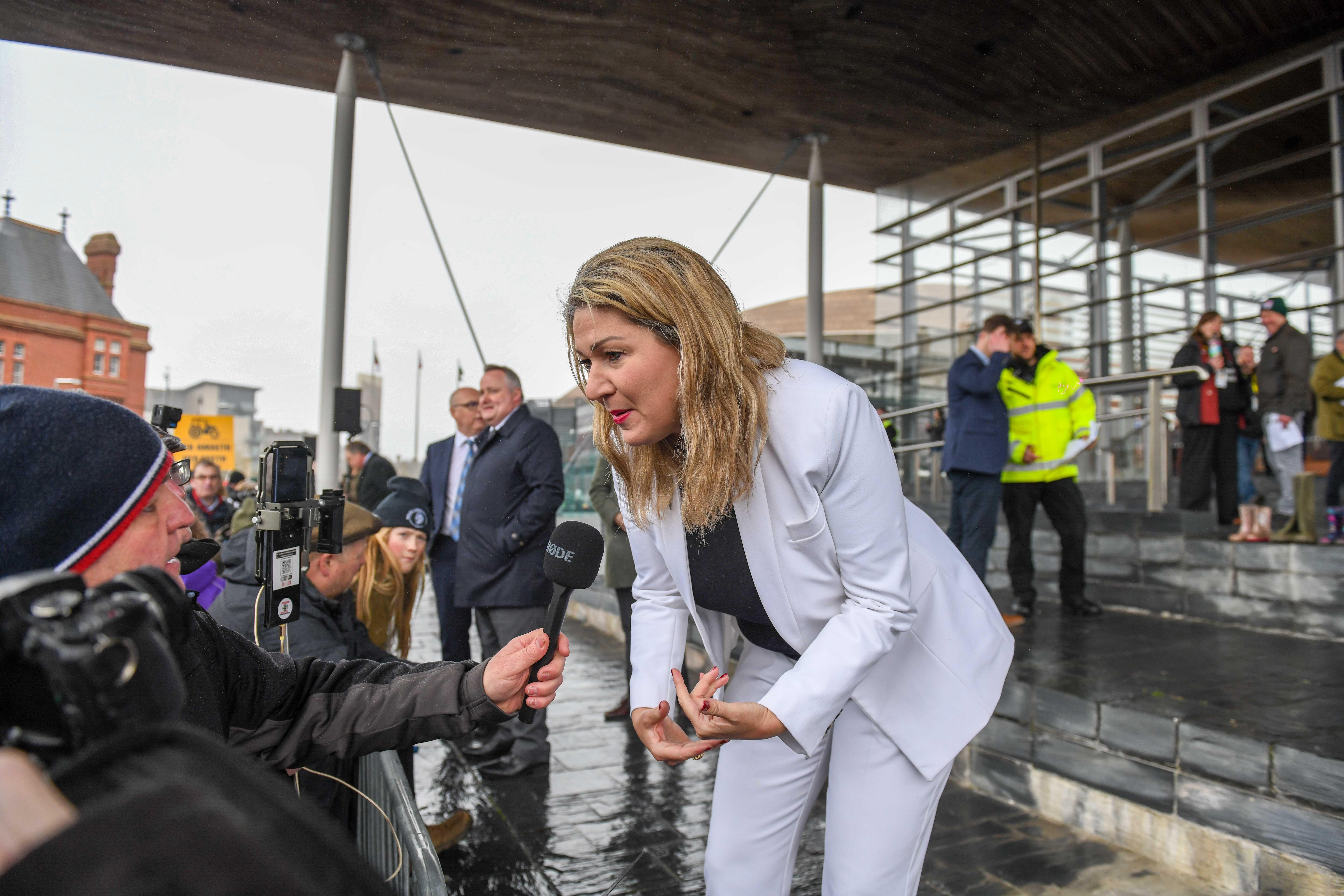
Reform UK gained its first foothold in the Welsh parliament today after Tory Senedd member Laura Anne Jones announced her defection, declaring Nigel Farage to be “a great man”.
Jones, a Member of the Senedd for South Wales East, confirmed her move at the Royal Welsh Agricultural Show alongside Farage, claiming: "I've just suddenly felt that the Conservative party was unrecognisable to me. It wasn't the party that I joined over three decades ago”.
Reform UK, she added, "is listening to the people of Great Britain".
Asked if she would be Reform's leader in Wales in the run-up to the Senedd election, Jones teased: "We'll have to see what happens, won't we."
Her defection comes a year after she was stripped of her position as the Tory party’s culture spokesperson for writing “no chinky spies for me!” in a WhatsApp chat. She has also been under investigation by the Senedd's standards commissioner Douglas Bain, a probe believed to be related to allegations of bullying. Jones has neither confirmed nor denied this, saying: “The standards process is confidential”.
Jones is the third prominent politician to jump ship from the Tories to Reform this month, following the defections of former Secretary of State for Wales, David Jones, and former party Chairman, Jake Berry.
Senedd Conservative leader, Darren Millar, said voters in South Wales East will feel "very let down by her announcement".
The defection - which means the Conservatives are down to 14 politicians in the Welsh Parliament - is undoubtedly a blow for Kemi Badenoch, and an unwelcome distraction from her shadow cabinet reshuffle today which brought James Cleverly back to the front bench.
Perhaps even more significant is what it forebodes for Labour, which has led every single devolved Welsh government.
Next May, voters across Wales will head to the polls to elect a new Senedd for the seventh time since devolution was first established in 1999. Current polling indicates that a dramatic political reconfiguration looms, in which Welsh Labour’s dominance will come to an abrupt end.
Reform has a good chance of being the largest party in Wales after next May's Senedd election. A poll conducted earlier this month by More in Common for Sky News puts Farage’s party in the lead with 28% of the vote, followed closely by Plaid Cymru on 26%, with Labour in third place on 23% and the Conservatives languishing behind with 10% of the vote.
This same poll also found that less than half (48%) of Labour’s 2024 voters would still back the party in a Senedd election if it were held today. The largest losses for Labour were to Plaid Cymru (15%), followed by Reform on 11%.
Farage has been especially keen to target voters from the valleys of South Wales, residing in the post-industrial towns that were heavily hit by the decline of the coal industry. Last month, the Reform UK leader unveiled his big plan to reindustrialise the region by re-opening the coal mines and the Port Talbot steelworks, Britain’s largest steel plant which closed last year.
Labour First Minister of Wales, Eluned Morgan, has dismissed Farage’s coal mine plan as “absolute nonsense”, insisting people in Wales “don’t want to see their grandchildren going back down the pits.” Next May will give us a better indication if she’s right.
The upcoming Senedd election will also be the first to use a proportional election system. This change makes it harder to predict the outcome, though some say a system based on percentage of vote share could further benefit an insurgent party such as Reform.
We can expect fiery debate amongst Welsh Labour politicians as to the correct strategy to stem their predicted losses: while they are under pressure to curb the rise of Reform, if the party leans any more to the right, Plaid Cymru stands to gain.
Big changes are afoot. Not only has Labour led every Welsh government since devolution was established 25 years ago, it has also been the biggest party in Wales in every election since 1922, giving it the longest winning streak of any political party in the world. That streak could soon be coming to an end.
Caitlin Allen
Deputy Editor
ON REACTION TODAY
Adam Boulton
Lords reform scratches a partisan itch without delivering worthwhile change

ALSO KNOW
Gazans starved to death by Israel - An estimated 33 Palestinians, including 12 children, have died of starvation and malnutrition in the past two days alone, according to Gaza’s health ministry. This brings the total number of deaths due to malnutrition to 101, of which 80 are children, since the beginning of the war in 2023. Israeli gunfire and military strikes have killed a further 72 Palestinians over the last day.
New UK government borrowing figures higher than expected - June’s public finances data shows that borrowing rose to £20.7bn last month, £3.5bn more than anticipated by the OBR and the second-highest borrowing figure for any June on record excluding 2020 during the pandemic.
Cleverly returns to Tory frontbencher amid reshuffle - Former Tory leader hopeful, James Cleverly, has been appointed today as shadow housing secretary, meaning he will replace Kevin Hollinrake and shadow Deputy Prime Minister Angela Rayner. Under Tory leader Kemi Badenoch’s reshuffle, Hollinrake will become party chairman while current chair Nigel Huddlestone will become shadow culture secretary.
Nukes deployed to UK for first time in over a decade - The US has deployed tactical nuclear weapons to Britain this week for the first time in over a decade, according to the UK Defence Journal. These weapons were reportedly transferred to RAF Lakenhealth in Suffolk, having been flown from the US Air Force Nuclear Weapons Centre at Kirkland Air Force Base in New Mexico. US and UK government officials are yet to comment.
FIVE THINGS
How much is the defence deal with the EU going to cost Britain? Eliot Wilson in The Spectator.
The Syrian state is unravelling, warns James Snell in Engelsberg Ideas.
Matan Chorev and Joel Predd in Foreign Affairs: America should assume the worst about AI.
Why we have no new ideas. Kit Wilson says we appear to have reasoned our way into an intellectual dead end, in The Critic.
What the cancellation of Stephen Colbert’s “Late Show” means. Vinson Cunningham in The New Yorker.
The Tata Steel plant at Port Talbot did not close last year. Instead, the (loss making) coal powered blast furnaces were shut down, to be replaced with an Electric Arc Furnace which will use recycled, UK-sourced steel as a feedstock. The transition to an EAF at Port Talbot is being paid for by a £750m investment by Tata Steel and a £500m grant from the UK Government.