


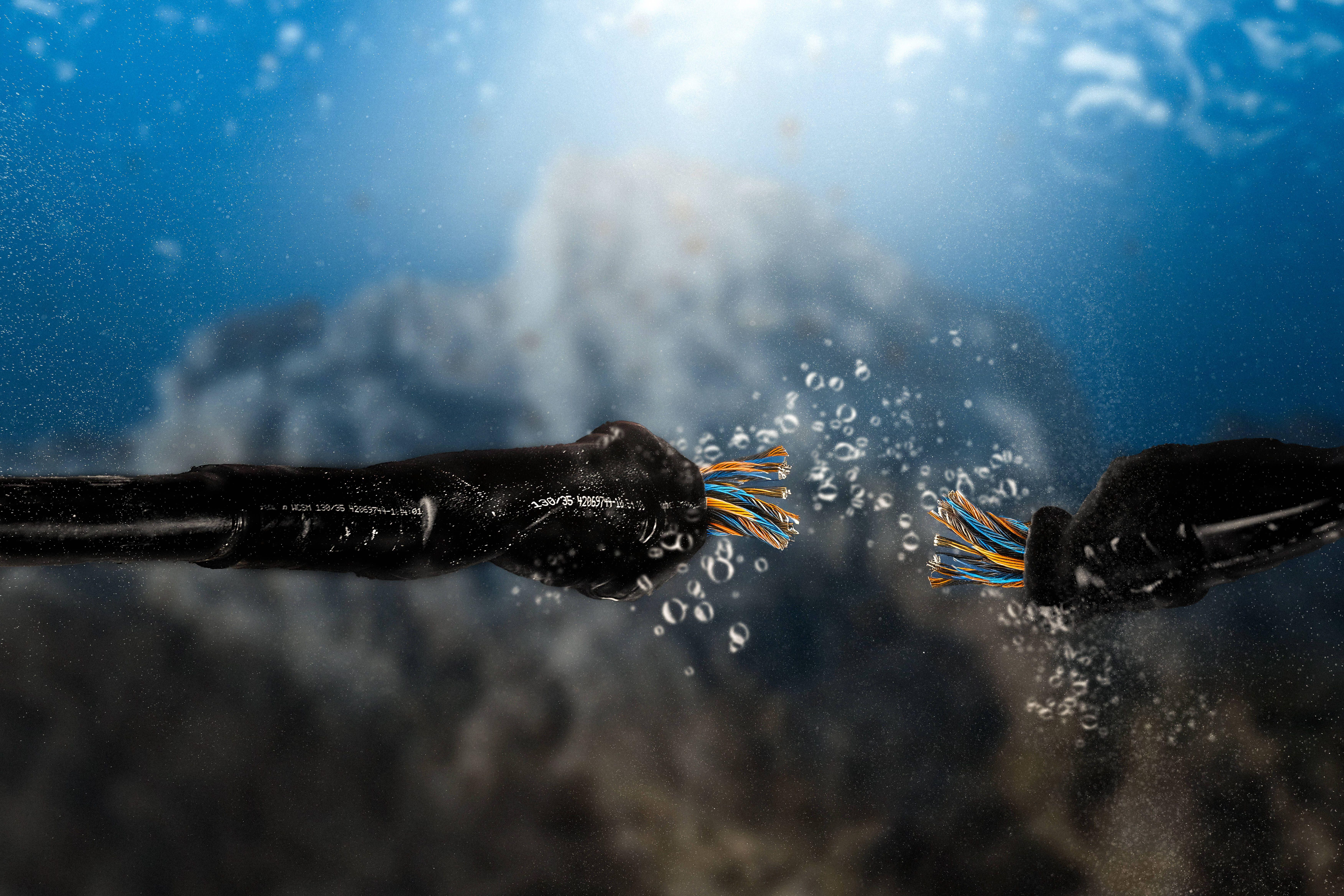
Events over the past eighteen months indicate that the threat of Russia- and China-backed sabotage of undersea cables is only going to rise, warns a new report examining a spate of suspicious incidents in the Baltic Sea and around Taiwan.
Submarine cables are critical infrastructure, essential for electricity supply and responsible for over 95 per cent of internet traffic. But they are operating in an “escalating risk environment”, according to cybersecurity company, Recorded Future.
In its new report, Recorded Future identified 44 incidences of global cable damages over the past 18 months. While acknowledging that accidents remain the likely cause of most undersea cable disruption, it singled out nine incidents of damage occurring in the Baltic Sea and off the coast of Taiwan in 2024 and 2025, five of which were attributed to ships breaking cables by dragging their anchors along the seabed.
Incidents flagged in the report in the Baltic include the severing of two subsea communications cables - one connecting Germany to Finland, the other linking Lithuania and Sweden - in November of last year. Investigators believe an anchor dragged by a Chinese cargo ship, the Yi Peng 3, was responsible.
The following month, Finland detained a Russian oil tanker suspected of severing cables between Finland and Estonia.
Recent incidents around Taiwan include a Chinese-crewed freighter back in February, between the island and Penghu Islands, which dropped its anchor near an undersea cable then proceeded to repeatedly manoeuvre in a zigzag pattern. A month prior, a Chinese-owned cargo ship was briefly detained by Taiwan’s coastguard after it similarly dropped its anchor and caused damage to a cable that runs to the US and is co-owned by several international companies.
As one investigator argued regarding the Yi Peng 3 incident, “It’s extremely unlikely that the captain would not have noticed that his ship dropped and dragged its anchor, losing speed for hours and cutting cables on the way.” Even so, as Recorded Future, point out, it is “difficult to definitively attribute recent incidents in the Baltic Sea and around Taiwan to state-sponsored sabotage”.
That this damage can be passed off as an accident is all part of what it makes it an attractive method of sabotage. Anchor-dragging, as the report puts it, can be employed by hostile states as a “low-sophistication tactic to target adversaries’ critical infrastructure while maintaining plausible deniability.”
Cable sabotage is not a new phenomenon. In fact, one of Britain’s first moves after declaring war on the Germans in 1914 was to sever all five of the undersea telegraph cables connecting Germany with the outside world.
As the world becomes increasingly more dangerous, it is an act of grey zone warfare that once again demands our attention.
Improved monitoring of subsea cables is vital to prevent a major attack on multiple cables simultaneously, which would cause “prolonged connectivity issues”, warns Recorded Future. This type of attack, it adds, would have to occur in deeper waters and would “very likely involve state-sponsored threat actors, due to the difficulty of accessing these sites”.
While it is a tall order to maintain surveillance on vast expanses of sea, the obvious recourse is to spot and track suspicious vessels. NATO is already attempting to do this, by establishing a stronger presence in the Baltic Sea. Back in January, it launched a new mission, dubbed operation “Baltic Sentry”, deploying more maritime patrol aircraft, warships and a fleet of naval drones to the region to act as a deterrent against cable sabotage.
Baltic Sentry was a mission spurred on by stark warnings from western intelligence agencies that Russia is mapping the undersea cable network.
Of utmost concern for Tapei, meanwhile, will be cable-cutting’s historical deployment as a method to isolate a country in advance of a full-blown military attack.
As Gerald Warner wrote recently in Reaction, “Anyone who remembers how Russian special forces cut cable links between Ukraine and Crimea, immediately before annexing the peninsula, will recognise the potential for the Chinese PLA similarly to isolate Taiwan on the eve of an invasion.”
Caitlin Allen
Deputy Editor
ON REACTION TODAY
Tim Marshall
Syria’s minorities will continue to live in fear

Neil Collins
Another counterproductive EV scheme

Gerald Malone
The Flying Dutchman: Borths conjures up a storm in this whirlwind opera

ALSO KNOW
Substantial increase in water pollution in England - Serious water pollution incidents have risen by 60 per cent in England, the Environmental Agency has said, with 2,801 reported cases in 2024 compared with 2,174 in 2023. The cross-party group of MPs, the Public Accounts Committee, have accused regulators of being “missing in action” in the face of such “woeful” levels of pollution. This comes as the Guardian reports that ministers are preparing to abolish Ofwat to create a new water regulator.
Trump asks Justice Department to release Epstein details - Donald Trump has asked the US Justice Department to release grand jury material related to sex offender Jeffrey Epstein, with his Attorney General Pam Bondi saying the government are ready to unseal transcripts. It comes after The Wall Street Journal published a report that Trump’s name appeared on a lewd letter in 2003 for Epstein’s birthday. The US President dismissed this as fabrication and threatened to sue the “ass off” of Rupert Murdoch who owns the paper.
Syrian ceasefire breaks - Syrian forces are being redeployed to the country’s Swedia province after renewed fighting broke out between a Druze militia and Bedouin tribes, breaking a ceasefire between the government and Druze agreed two days ago. The conflict has claimed nearly 600 lives since Sunday, according to the Syrian Observatory for Human Rights.
FIVE THINGS
India’s war on the Mughal Empire. Richard Eaton in Engelsberg Ideas.
Trump’s Ukraine U-turn is less than it seems, writes Gerard Baker, in The Times.
Taylor Fravel asks: is China ready for a war? In Foreign Affairs.
The Spectator’s Matthew Bowles on why Britain is ready for a Reagan.
Anoosh Chakelian asks who is an acceptable migrant? In The New Statesman.