


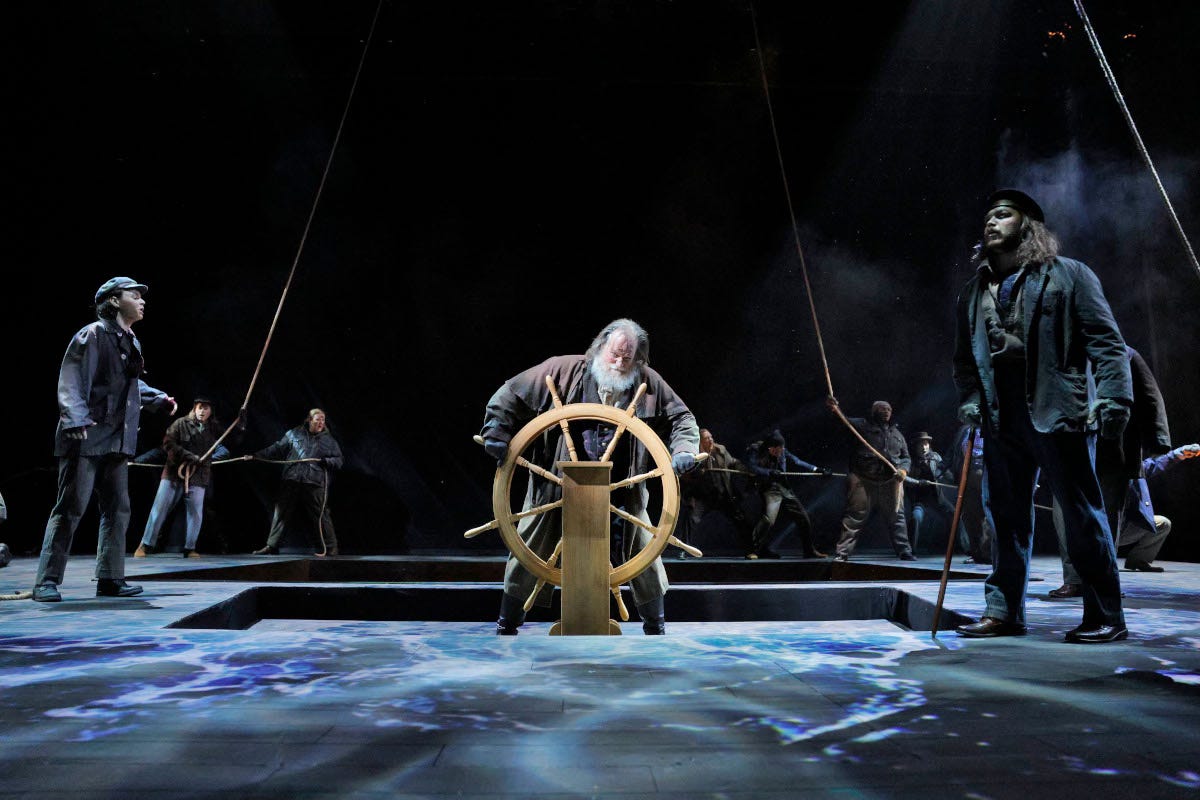
Life can be hell. Especially if you are captain of a Dutch fluyt, a three masted galleon of sorts, “The Flying Dutchman”. And make a wild wish to round the Cape of Good Hope in a storm. “I will sail on even if it takes to eternity.”
Alexa being offline in the 17th century, on cue up pops Satan instead, grants the wish, but condemns you to sail the seas – for eternity - as a ghost ship. Someone has always been listening. Not just the Chinese on their Huawei routers.
Good news for Cap’n Dutchman. A nearby hovering angel takes pity and allows him and his crew to make landfall every seven years. If on shore leave the captain can find the love of a woman who will remain faithful until death, the curse will be lifted.
Snafu. You won’t find them all in The Bosun’s Arms, carousing, slugging back tots of celebratory rum afterwards. Their souls will be released, and they will shoot, presumably heavenwards. The angel was not precise with the terms and conditions. The captain, like us all, had mindlessly checked the “Accept All” box.
Maritime Tinder not being as reliable as now, on each seven-year itch landfall the captain had been let down by the gals. May have had something to do with the salt-smelly coat and the dank, devil-may-care locks.
Then Richard Wagner steps up to the plate and offers deliverance, of a sort with an opera. Fleeing his creditors in Riga – he had been music director of the City Theatre - with his then wife, Minna, he had endured a frightful Black Sea crossing, holed up in fjords for days.
Baltic shipping companies not being much into refunds, he decided to write The Flying Dutchman as a sort of Trip Advisor revenge.
Last summer I had rounded the cape of Des Moines Metro Opera to see a fabulous production of Richard Strauss’ Salome. Directed by my friend, Alison Pogorelc, who had stepped in at the last minute and delivered an electrifying show.
Not least because she made artful use of a probably unique performance space. The Pote Theatre, the Blank Performing Arts Center, Indianola. I had casually expressed a wish to return and at the encouragement of Artistic Director, Michael Egel, found myself in town for a maritime opera about as far from either American bounding ocean as you can be.
The theatre is in the semi-round, but the orchestra is completely below stage, the sound emitting from a large rectangular aperture mid performance space. This is both a hazard to be negotiated – careless mezzos may topple into the pit – and an opportunity to be exploited for directors who take care with their blocking instructions. That means carefully positioning the singers during the action.
As Pogorelc had with Salome, Director, Joshua Borths used the space to great effect. Essentially, the huge hole in the stage allows directors more easily to distance characters from each other symbolically – and when the moment in the libretto demands it, bring them together.
The Pote also boasts a front of stage lift, located in front of orchestra gulch, which allows dramatic entrances from below. And, as if that wasn’t sufficient, director’s gold dust, a front stage entrance from a staired tunnel.
“Enter stage left, right, back, below or up the tunnel.” Borths was spoilt for choice, and he didn’t miss a trick. Dutchman is a whirlwind of an opera and he conjured up an action-filled storm.
For the famous overture with its sizzling string and brass fanfare introduction, Borths had devised a staged prequel, the likes of which I have not seen before.
Conventionally, the curtain remains down, or there is a scene – as in the current Met production – with Senta, a central character in the story, Daland’s daughter besotted with the Dutchman, danced by a double. Writhing, like a love-stricken dervish, in sync with the leitmotif laden music.
In Indianola from below stage, via the lift, emerged Senta’s childhood bedroom, a narrative of her being read a story of the doomed sea captain, and becoming bewitched. She tears the portrait of the captain out of the book and keeps it constantly with her through the following action.
Most productions simply have her hang it on a bedroom wall, like a maritime Elvis crush. Clutching it to her bosom throughout flagged obsession. And Senta’s obsession is central to the plot.
That plot is. Act I
The Norwegian coast, 19th century. A storm has driven captain Daland’s ship several miles from his home. His crew resting, he leaves the watch in charge of a young steersman, who falls asleep as he sings about his girl.
Steersman was Demetrious Sampson Jr. a tenor from Albany, Georgia, plucked from the Sarah and Ernest Butler Studio at Houston Grand Opera. I heard him as one of the finalists at Met’s Laffont Competition and was pleased to see he can act fully in character as well as be a fluid voice on stage. Good spot for Des Moines’ casting team.
A ghostly schooner drops anchor next to Daland’s ship. “The Flying Dutchman”. The captain steps ashore and immediately establishes a presence that will dominate the rest of the action. Ryan McKinny is one of the most characterful bass baritones on the circuit. I heard him take on the role of condemned prisoner, Joseph De Rocher, alongside Joyce Di Donato in Dead Man Walking at the Met. Now he has moved on to Dead Man Sailing.
His voice at the Met was described as “figurative and muscular”. And he translated perfectly to this tortured role. Capable of maintaining a presence even during long moments of stage silence he has all the weight for a dazzling Wagnerian future,
That he was to be found onstage in Des Moines speaks volumes about the house’s growing reputation in American operatic circles.
Daland discovers the phantom ship, and the stranger, who introduces himself as “a Dutchman,” tells him of his plight. The Dutchman offers gold and jewels for a night’s lodging, and when he learns that Daland has a daughter, asks for her hand in marriage. Happy to have found a rich son-in-law, Daland agrees and sets sail for home.
Observant readers will have spotted that Senta has absolutely nothing to do with this cynical arrangement. Dad Daland is a dastard. And that was the one flaw in this production. Bass baritone, Kristopher Irmiter, was faultless in his singing, but came across as a kindly, if misguided, Santa Claus.
Act II
Senta is still captivated by her portrait of a pale man in black - the Dutchman. Her friends, a chorus, sewing and spinning under the watchful eye of Mary, Senta’s nurse, tease Senta about her suitor, Erik, who is a hunter, not a sailor. They all have sailor boyfriends.
When the superstitious Mary refuses to sing a ballad about the Dutchman, Senta sings it herself. The song reveals that the Dutchman’s curse was put on him for a blasphemous oath. To everyone’s horror, Senta suddenly declares that she will be the woman to save him.
Senta was soprano Julie Adams. Another “catch” for Des Moines. She negotiated the complex path between true love and childish obsession with skill. The innocent girl who during the overture had ripped the page from the book had developed a true passion and the lady was never for turning. Her voice had more than sufficient depth and colour to underpin the sentiment.
Luckless boyfriend Erik enters with news of the sailors’ return. Alone with Senta, he reminds her of her father’s wish to find her a husband and asks her to plead his cause, but she remains distant. He loves her despite her flaunting that damned Dutchman’s picture in his face.
Joseph Dennis, another rising star American tenor, has a flourishing track record in the USA and Europe, singing many challenging roles. He is a sort of Don Ottavio character, the luckless schmuck fiancé of Donna Anna in Mozart’s Don Giovanni.
He tells her of a frightening dream in which he saw her embrace the Dutchman and sail away on his ship. To his despair, Senta declares, “You’re right!”, and prepares to do just that.
For, a moment later, the Dutchman enters and Senta stands transfixed. There followed a classic moment when a director with vision hits the jackpot. Senta was fiddling with her portrait of – now – the man standing before her. The Dutchman was looking at a miniature of – presumably – Senta.
As they eyed each other up, they circled the orchestra pit. Mutually fixated, but wary. Imaginative use of the space. But when the moment of commitment arrives, they come close to each other front of stage. She stuffs the portrait hurriedly into her bosom. He pockets the miniature. That is the turning point. The dream has become reality. Despite the fearful consequences. She assumes the Dutchman’s coat. Brilliant.
Senta vows to be faithful to him unto death. Daland is overjoyed. Dad is rolling in dosh!
Act III
At the harbor, the villagers celebrate the sailors’ return. Baffled by the strange silence aboard the Dutchman’s ship, they call out to the crew, inviting them to join the festivities. Suddenly the ghostly sailors appear, mocking their captain’s quest in hollow chanting.
The villagers flee in terror. Quiet returns and Senta appears, followed by the distressed Erik. He pleads with her not to marry the Dutchman since she has already pledged her love to him.
The Dutchman, who has overheard them, abandons all hope. She has loved another and that means, to him she is unfaithful. Strict interpretation of unfaithful. He boards his ship. When Senta tries to stop him, he explains she will escape damnation—the fate of those who betray him—only because she has not yet proclaimed her vows before God.
He reveals his identity – as if we didn’t know it - and Senta ecstatically replies that she knows who he is. As his ship pulls away, she throws herself into the sea, faithful unto death. Not into the orchestra pit. Backstage.
Above all else, The Pote Theatre experience is one of audience intimacy. A bonus. But it comes with a directorial challenge, because the audience is privy to everything.
During the spinning chorus, where the chorus was divided into spinning and embroidering groups, every chorus member was engaged as if in a different conversation with her friends. Singing in tight ensemble, and to the front, is child’s play in comparison.
And in the closing moments, Borths delivered a heartwarming tableau to send the audience out to the lobby and the copious supplies of free popcorn, contented. From below the stage emerged the entwined Dutchman and Senta. They had found each other in death.
I was seated atop the tunnel from which the cast exited after their bows, to universal acclamation. Three feet away. Reading the expression on Adams’ and McKinney’s faces, they were fired up. They knew they had nailed it.
Des Moines Metro Opera has established itself as one of America’s leading opera festivals. Nominated and selected as a finalist for last year’s International Opera Awards – I think I was one of the nominators – the company’s growing reputation will inevitably extend its reach to audiences beyond the USA.
I had the pleasure of dining with Egel beforehand. He leads an innovative production team, an excellent orchestra led by Principal Conductor and Music Director, David Neely, in the pit.
With the ability to attract talented principals, that unique Amphitheatre and plans to scale new heights in the 25/26 season and beyond, Egel is an Artistic Director on a mission.
I travelled on to Glimmerglass with the conviction that, having built sure foundations, Michael Egel and his team are poised to take Des Moines Metro Opera on, to even greater things.
Read more from Gerald Malone on The Rest is Opera
