


Volodymyr Zelensky is facing one of the most difficult weeks of his presidency to date as the war with Russia rages on, after yesterday’s peace talks failed to yield any progress towards a ceasefire, and a new challenge arises: quelling domestic unrest.
Russia launched 103 attack drones and four missiles at Ukraine overnight, killing three people in the Kharkiv region and wounding at least 10 in Cherkasy, including a 9-year-old child.
The ambush came hours after a Russian and Ukrainian delegation held a third round of peace talks in Istanbul yesterday. The meeting lasted just 40 minutes, with little agreed upon besides further prisoner exchanges. Russia’s rejection once again of Ukraine’s US-backed proposal for a 30-day unconditional ceasefire suggests that Putin has no intention of de-escalating his war in Ukraine and is unfazed by Trump’s tough talk about a 50-day deadline.
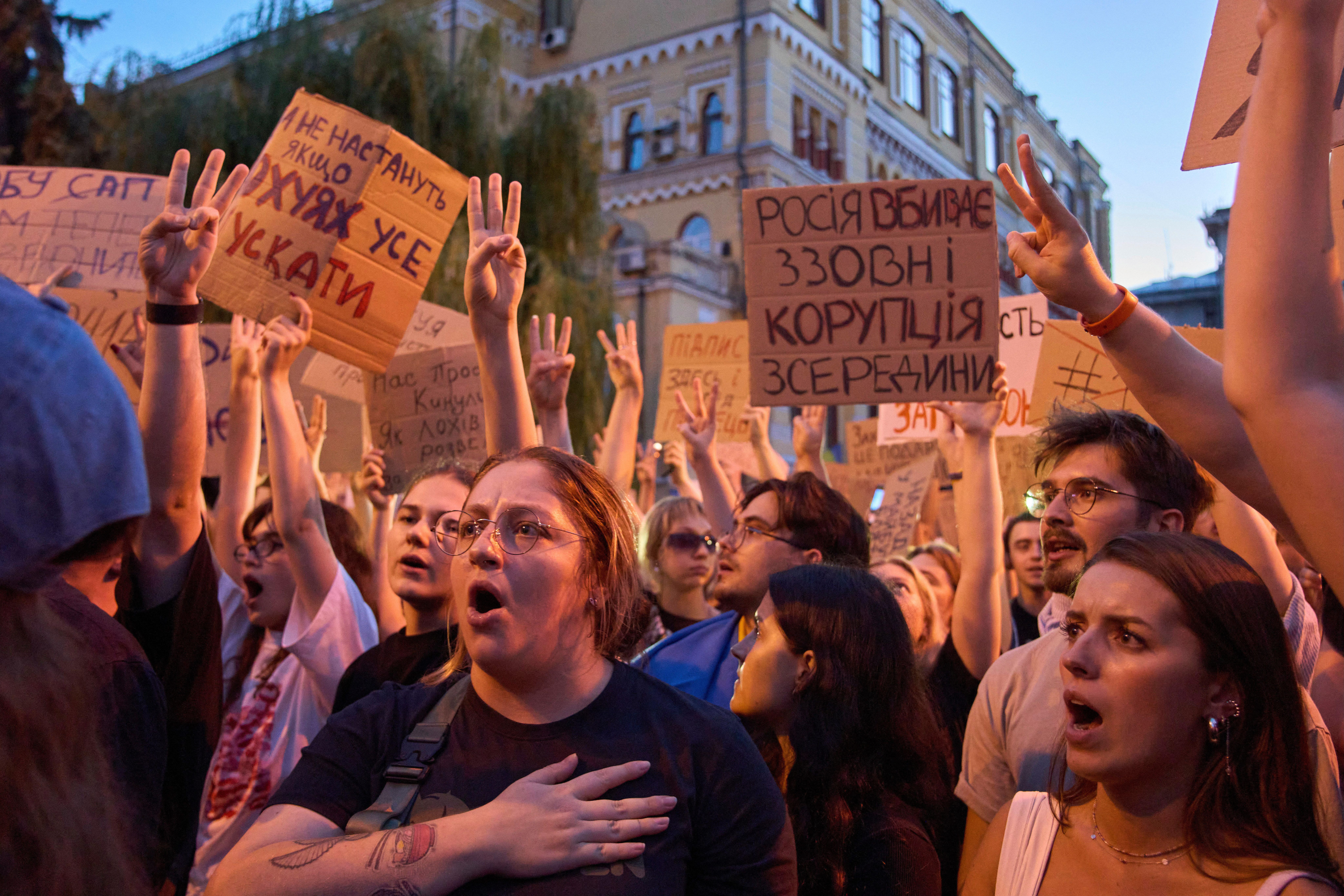
Meanwhile, Zelensky faces a further headache at home after a bill passed by the Ukraine’s parliament earlier this week sparked the first major anti-government demonstrations since Russia’s full-scale invasion began.
Thousands of Ukrainians in Kyiv, Lviv, Odessa and Dnipro have taken to the streets since Tuesday after Zelensky signed a controversial new bill into law which would effectively curb the independence of Ukraine’s anti-corruption agencies.
The law passed on Tuesday brought the country’s National Anti-Corruption Bureau (NABU) and Specialised Anti-Corruption Prosecutor's Office (SAP) under the control of the prosecutor general, who is appointed by the president.
These two key anti-corruption agencies were set up after Ukraine’s 2014 revolution toppled a pro-Russian government and set Kyiv on a western course. These independent bodies work to weed out high-level government corruption - a central requirement for Ukraine to receive Western aid and a precondition for it progressing on its path to EU membership.
NABU in particular, while not devoid of problems, is widely acknowledged by Ukrainian and Western experts as one of the country’s most important post-Maidan reforms.
During the war, both agencies have ramped up their work, bringing charges against a swathe of politicians and senior government officials in Zelensky’s administration.
This week, the Ukrainian President -who promised “victory over corruption” after his 2019 election - insisted that a law to increase government oversight of these anti-corruption agencies is intended to “cleanse” them of Russian influence and prevent them from being co-opted against the Ukrainian state. It comes after Kyiv’s domestic security agency arrested two NABU employees on suspicion of their ties to Moscow.
Critics of the bill are unconvinced. Many civil society experts view the attempted purges as payback for NABU pursuing charges of illicit enrichment and abuse of office against former deputy prime minister Oleksiy Chernyshov, a key ally for the Office of the President.
Amongst the Ukrainians taking to the streets to protest this “democratic backsliding”, emotions are running high. One demonstrator - just steps away from the site of the 2014 uprising, itself sparked by a democratic rollback - held up a placard yesterday with the message: “My brother didn't die for this kind of future”.
Now, Zelensky appears to have backtracked. He announced today that he will submit an alternative bill to guarantee the autonomy of both anti-corruption bodies. In his message on social media, he did not acknowledge the protests or the backlash but said it was "important that we respect the position of all Ukrainians and are grateful to everyone who stands with Ukraine."
The latter part of his message is a nod to the fact his bill didn’t just prompt a domestic backlash - Kyiv's European allies also expressed serious concern over the legislation. The EU Commissioner for Enlargement, Marta Kos, warned on Tuesday that the independence of NABU and SAPO was “essential” for Ukraine’s EU path.
With no end to the war in sight, the last thing Kyiv wants to do is alienate its European partners - partners who have had to repeatedly rebut the Kremlin’s portrayal of Ukraine as a hopelessly corrupt country undeserving of aid. This week, Zelensky risked fuelling Putin’s fire.
Caitlin Allen
Deputy Editor
ON REACTION TODAY
Gerald Warner
Arresting economists is the last resort of Venezuela's bankrupt regime

ALSO KNOW
Thailand-Cambodia border clashes kill at least 12 - At least 12 Thais, mostly civilians have died after Thai and Cambodian forces clashed along their disputed border, with relations now at their lowest point in decades. Thailand has deployed fighter jets, while Cambodia has fired artillery and rockets. Cambodia has yet to confirm whether it suffered any casualties.
Starmer and Modi sign trade deal - The signing of a trade deal between the UK and India today has been described as “historic”, by Keir Starmer and Narendra Modi, who described London and Delhi as “natural partners” while addressing an audience at Chequers. The agreement is expected to boost the UK economy by £4.8bn and bring in £6bn worth of investment by British and Indian businesses. Additionally, Indian tariffs on UK goods will be slashed from 15 to 3 per cent.
Cornyn launches new party - Former Labour leader Jeremy Corbyn has officially launched a new political party, unnamed as of yet, to “take on the rich and powerful”, alongside Zarah Sultana who recently quit Labour. They labelled the current political system as “rigged” and called for a “new kind of political party, one rooted in our communities, trade unions and social movements”. Corbyn, who led Labour to its worst election defeat in 2019 since 1935, lost the Labour whip in 2020 soon after Keir Starmer became leader of the party.
FIVE THINGS
New Statesman on why Tory insiders view Badenoch’s shadow cabinet reshuffle as “weak” and “delusional”.
How long can Ofcom allow Nigel Farage to keep his own show? asks Prospect
Stefan Wolff in The Conversation: both Russia and Ukraine are waiting for Donald Trump’s 50 days to run out.
Chloe Farland on the precious 'white gold' fuel buried in the Earth, in BBC Future.
The coming Pax Geriatrica. Mark L. Haas, in Foreign Affairs, on how aging societies and depopulation will lead to fewer wars.