


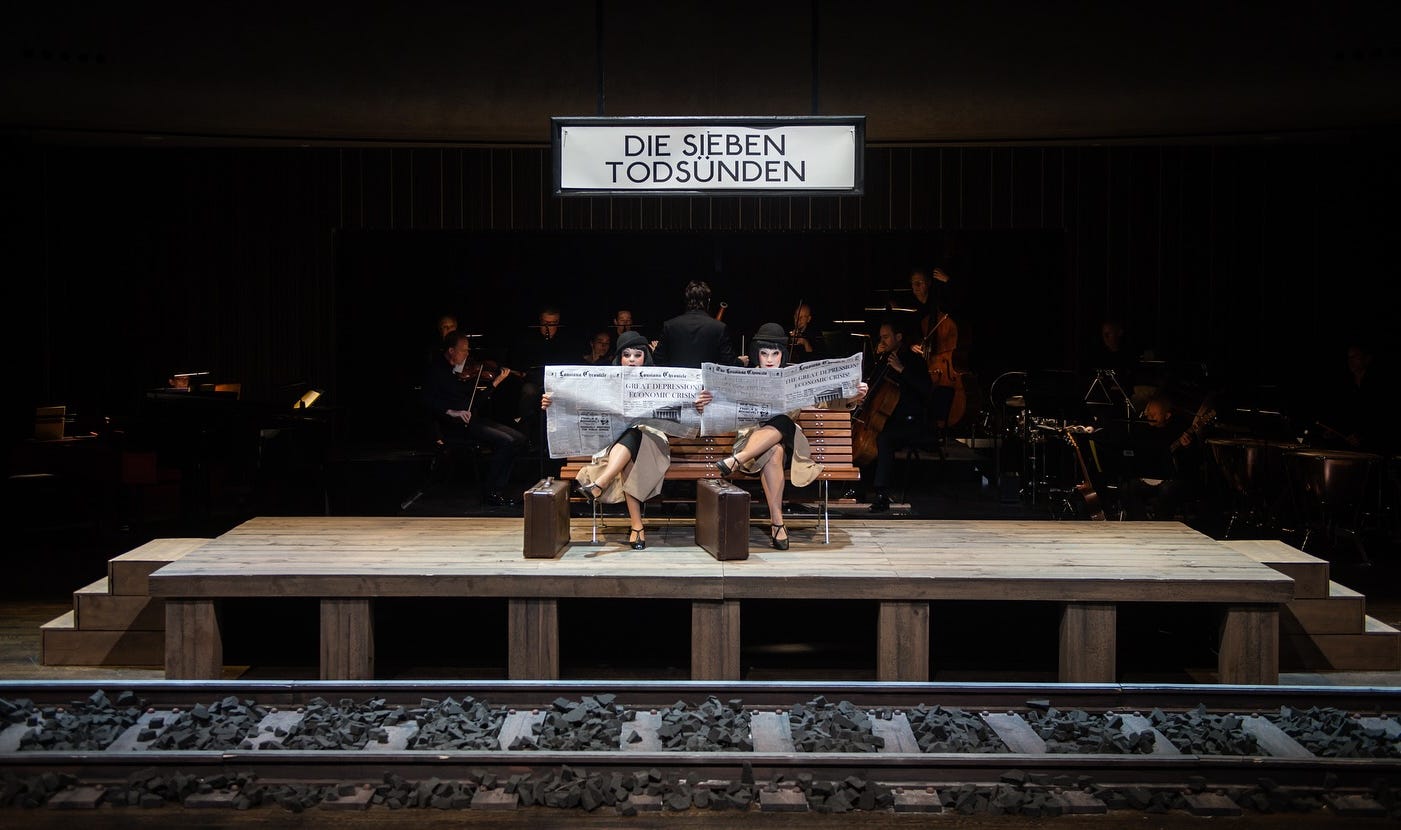
The dead giveaway that something special was afoot in The Hague was the rail track extending from the stage into the café outside the auditorium, where a curious audience was gathering.
Even before curtain up, the fourth wall separating audience from stage had been breached. During the performance it was to be smashed to smithereens.
The occasion, a perfectly matched double bill. Kurt Weill and Berthold Brecht’s 1933 Die Sieben Todsünden (The Seven Deadly Sins) and Viktor Ullmann’s 1943 Der Kaiser Von Atlantis. In one short evening, a satirical opera of Germany’s Weimar era premiered in Paris was to be followed by one inspired by the Holocaust.
Der Kaiser was composed by Ullmann, libretto by Peter Kien while prisoners in Theresienstadt concentration camp, about the absurd dictator, Emperor Overall. They did not survive to see their work performed. Hardly surprising. The read-across to Mein Fuhrer was far from subtle.
As powerful and evocative a pairing of operas defining the cruelty and absurdity of the Nazi era as I have ever experienced.
I was in The Hague, at the Conservatoriumzaal at Amare, on the fourth floor wonder of a purpose-built building that can host 6,000 visitors in varied spaces, catering for every art form under the sun. The oval space is flexible, seats 300, but has no backstage, flies or space for concealed entrances stage left or right.
The rail track which ran in front of the stage, from right to left, and projected into the café was a neat device for rolling sets on and offstage on open wagons. Cloaked in black, as it projected into the café.
And with chilling purpose, too. Being modelled on the famous memorial at the Dutch transit Camp Westerbork where over 100,000 Netherlander Jews were held, awaiting onward transport to death camps in Poland.
In The Seven Deadly Sins, this was just a track to facilitate scene changes. In Der Kaiser Von Atlantis, the iron had morphed during the interval into a passable facsimile of the memorial. A single track with both rails, stage right, twisting grotesquely skywards. In hopeless supplication.
The catalyst for this Hague odyssey was my friend Floris Visser, opera director extraordinaire with a flair for creating atmosphere. His 2022 Glyndebourne La bohème, set in a real Paris street and featuring a solemn black clad figure representing death stalking Mimi, comforting her after she dies, earned universal rave reviews. Including mine.
It was the same in Copenhagen in April 2024 with Puccini’s Madama Butterfly. Visser has a knack of drawing something fresh from a production without twisting the composer’s work into his own. Unlike the relentlessly self-indulgent Barrie Kosky in his recent Vienna Mars-scape farce of Don Giovanni.
The Weill/Ullmann doublers were both student productions, performed by talented young artists of The Dutch National Opera Academy, along with musicians of the Resident Orkest. Visser was lending a helping hand.
This was to be no amateur evening out. The students, fired up by a stiff measure of Floris Bruichladdich 184 proof, delivered two stunning shows that could have graced any main stage house – in any capital city!
By 1933, Weill and Brecht had chosen exile in Paris, shrewdly understanding that in newly elected Chancellor Hitler’s Germany the intellectual lefties were destined to be classified as degenerates, marked men.
The Seven Deadly Sins is a sung ballet, following a poor family in Louisiana who ruthlessly send their daughter Anna out on a seven-year sortie around America, to earn cash so they can build a family home on the banks of the Mississippi.
Not so far removed from the life story of many immigrant Uber drivers in New York today, strivers struggling to give their families that kick start towards prosperity.
There are two Annas. Anna 1 and Anna 2. Yes, it’s complicated. Weill was married - on and off - to Lotte Lenya, a fabled, sultry Austrian American singer he wanted to cast as Anna. Snafu was the angel funder of the work, rich Englishman Edward James, had an estranged wife, Tilly Loach, he wanted to dance the role.
Hence the two Annas. Anna 1 the singer, Anna 2 the dancer. Anna 2 speaks only occasionally and never sings. To the sung line “Isn’t that right Anna?” Anna 2 intones, usually resignedly, “That’s right, Anna!”, constantly fusing both characters.
Sound like a perplexing nightmare? It works well if Anna 1 and Anna 2 have clearly defined personalities locked up in the single character. Facilitating an internal moral debate about their journey through the deadly sins in pursuit of cash.
I’ve seen productions where the two Annas are quite distinct. Squabbling twins. But it is far more powerful to fuse them as one character with two dimensions, as in the Hague. It makes their constant self-scolding and bickering the more comical.
The first deadly sin, Sloth, has the family shunted on stage lecturing Anna not to be lazy. A fine irony, considering they are waiting in Louisianna for her to shower the do-nothings with cash. There is a family quartet, Weill poking fun at the barbershop style, with mother as a bass.
Pride is set in Memphis to a cabaret waltz in which Anna 2 comes to the fore. Basically Anna 2 is not earning money because she won’t strip. So, she strips. The cash rolls in.
In Anger, the Annas have reached Hollywood. Anna 2’s anger at seeing an extra being mistreated nearly gets her fired. The capitalist-driven movie industry is a school of hard knocks.
For Gluttony, Anna has signed a lucrative singing contract but has agreed to a “weight” clause. She can’t gain an ounce and is weighed regularly to keep the cash flowing. The family intervene lecturing her a cappella again.
Lust is an elaborate dance scene for Anna 2. Tilly Loach was coming into her own. In Boston, Anna 2 has become the kept woman of the rich Edward, but Anna 1 has fallen in love with the poor Fernando. Pathos meets comedy as Anna 1 prudently dumps Fernando.
In Covetousness Weill has the father sing a parody of an opera aria setting out worries that Anna is leaving a swathe of men financially ruined and getting a reputation for greed. Heaven forfend! Hypocrisy to the fore, as the building fund increases.
Envy is a triumphant march on the surface, but with a painful undertow as Anna 1 and Anna 2 realise Anna will never be happy until she has summoned the strength to conquer the seven deadly sins.
Conventionally, this is the point where the family home has been built, the Annas return to Louisiana to a welcoming hearth. No chance with Visser providing a twist to the tale.
As the Annas first set out on their American route march there was an attention pricking episode I hadn’t encountered before. A lover had been murdered, and the Annas had to flee justice, giving another motive for their extended seven-year tour on Route 66.
Now, instead of a cute timbered home on the banks of the Mississippi awaiting their triumphant return, a large prison cage was trundled on using the rail tracks. For Anna 1 and Anna 2, it was a fair cop. They were locked up holding nowt more than a nostalgic model of that dream house.
“The seven deadly sins didn’t pay. Isn’t that right, Anna?” “That’s right, Anna!” Intensely moving. And hilarious.
Der Kaiser von Atlantis, the second half of the double bill, could have been a skit on a present-day current affairs documentary. The piece confronts the absurdity of the abuse of absolute power.
The Kaiser Overall, in this production an absurd character barking orders down telephones relayed by cronies over loudspeakers to a compliant populace is intent on conflict, declaring universal war. He’s gone so far as to usurp the role of death, who goes on strike.
Life becomes unbearable as the victims of battle become a battalion of the undead. The only way to restore balance is for the Kaiser himself to be the first to die. Death – assisted by his accomplice Harlequin – will return to work. Only then will life return to normal.
This vignette, still-born in Theresienstadt, was given posthumous authenticity in The Hague by being costumed in prison camp uniforms, with the tracks leading to the death chambers in plain sight. The Kaiser became mortal only when he dumped his elaborate uniform and dressed as an inmate.
Again, Visser’s staging was powerful and compelling. Singers popped up in the audience barking the Kaiser’s increasingly impossible instructions. Details matter. In his descent to lunacy the Kaiser strutted, one hand behind his back, twitching uncontrollably, patting increasingly junior soldiers on the cheek. Reminiscent of real footage of Hitler awaiting his final downfall in the Berlin bunker.
Kaiser Overall barked into his phone in the tones of today’s invading dictators and purveyors of simplistic solutions, making everything “great” and “beautiful”.
Floris was kind enough to arrange preshow conversations with three young artists. The Academy caters for an international intake. All three were totally committed, itching to get onstage and when they did, gave a wonderful account of themselves.
As I was mulling over my conversations with a fortifying double espresso, Paul McNamara, the Artistic Leader of the Dutch National Opera Academy, dropped by and introduced himself. A tenor in his own right, he revelled in the work being done by his students, bringing together the talents of voice and acting.
The degree of support for the students’ holistic approach to presenting a properly staged opera is remarkable. Anna 2, Demi Wals, was one of the artists – choreography – I spoke to beforehand. Down to earth, prepared to muck in at any level and determined to be part of the generation that brings opera to a younger audience.
Short, snappy shows with impeccable intellectual roots but as accessible as a Netflix special should be on any opera house’s radar. “I think this Floris Visser production should go viral, Anna!” “Yes, Anna. It must!”
