


“I live neither in the past nor the future. I am in the present. I cannot know what tomorrow may bring forth. I only know what the truth is for me today. That is what I am called upon to serve. And I serve it in all lucidity.”
Thus, spake composer Igor Stravinsky explaining his career long development of musical style. His three widely recognised phases, the over-neat boxes of Russian, Neoclassical and Serialist, do not even begin to address the evolving complexity that lies at the heart of the lifelong oeuvre of, arguably, the 20th century’s greatest composer.
Stravinsky was never for being neatly boxed. From the Paris audience riots that greeted his 1913 premiere of The Rite of Spring, to the glass-shard like Requiem Canticles of 1966, Stravinsky’s compositions were always his truth of today. Quite impossible to categorise. Don’t even go there.
And in no work does that truth come together in a miraculous blend of blazing virtuosity and onstage excitement more than The Rake’s Progress, his only full scale opera, premiered at La Fenice, Venice in 1951.
Said to mark the end of Stravinsky’s neoclassical period – “The boxes, the boxes, the damned boxes!” – Rake is one of the most difficult operas for houses to perform, because of the complexity of harmony, non-stop sequences of rapid rhythm changes, sudden shifts of time signatures, tempi, and dynamics. Not to mention the vocal range demanded of the principal soprano character who figures in the piece, Anne Trulove.
That is why it has taken fifty years until The Rake’s Progress premiered at the Glimmerglass Opera Festival. The stars of orchestral skills, production and voice needed to align perfectly, else audiences would be served up a Rake’s Fiasco. Be under no illusion, this is opera on a tightrope.
Difficult enough to pull off in an established house armed with all the necessary bells and whistles, a crazy challenge for a summer festival.
To mark the 50th Anniversary milestone moment of the opera house on the lake in upstate New York, Artistic Director Robert Ainsley and Music Director Joseph Colaneri made a judgement call. The truth for today’s Glimmerglass was that they could pull it off. Took the plunge. And pull it off they and their whole team did.
I was privileged to see Rake twice. The dress rehearsal on the Thursday was stunning, but with the singers marking (holding back) slightly, merely a taster for the Saturday matinée premiere. That is when the Stravinsky bud burst into full, glorious bloom on Lake Otsego.
Over breakfast on Friday, Maestro Colaneri had explained to me the complexity of the score. Stravinsky has created a fragile musical crystal requiring taut observance. There is no room for taking whimsical liberties. The conductor’s task is to deliver the composer’s truth. One false move – a careless change of tempo – the voice is lost, the crystal shatters and the performance fails.
The opera is based on William Hogarth’s 18th century series of eight paintings depicting the fall of Tom Rakewell, a spendthrift who comes into an inheritance, moves to London, wastes his fortune and ends up in Bedlam.
Sarah Young, with whom Tom has a common law marriage in Hogarth’s paintings, becomes the character Anne Truelove (great name) in the opera.
Stravinsky viewed a set of the etchings at the Art Institute of Chicago in 1947 and – slam dunk – this would be the subject of his opera in English. For some years he had been looking for a suitable subject for an opera to fit a libretto in the native tongue of his adopted country, America. It was to be a “thank you” tribute from the Russian born composer.
Serendipitous that his friend Aldous Huxley would introduce Stravinsky that same year to the poet W H Auden, who along with Chester Kallman agreed to write the libretto.
Operas sung in English generally enjoy a bad reputation. Clunky phrasing. Vowels and consonants in all the wrong places, like sand in your swim shorts. Awkward to sing. But that need only be true of libretti translated from Italian, French of German. With words shaped in true collaboration to blend with the score English works, as in Rake.
Nine years after Stravinsky wrote Rake, Benjamin Britten delivered A Midsummer Night’s Dream, the score moulded carefully to accommodate Shakespeare’s verse. Opera in English needn’t be all musical road bumps.
Stravinsky’s collaboration with Nadia Boulanger, his friend and mentor while composing Rake was intense. Often composers are thought to be furrow browed, scribing scores solo in their garrets. Think Mahler in his summer house on the lake. Or Sibelius in his Swedish pub …… er, maybe not.
Stravinsky sought his inspiration wherever he found a well of truth. Boulanger worked over three volumes of summary sketches of Rake for him. After 1946, he also had an American amanuensis, Robert Lawson Kraft, composer and writer, who was always by his side during studio recordings.
Relationships had always mattered for Stravinsky. Since his collaboration with Diaghilev composing The Rite of Spring, he always kept friends close, even when gently mocking them. Once asked if Diaghilev was as formal a person as he was a stickler for artistic performance, Stravinksy mused: “I’m not really sure, but he does have one of his servants say his prayers for him.”
For deep dive readers I strongly recommend an excellent book by Kimberly Francis, The Last Project: The Rake’s Project, 1948 – 1952. Not least, Francis has amassed a treasure trove of correspondence between Boulanger and Stravinsky. Nadia was truly the “go-to” influencer of 20th century classical music.
Newcomers to opera, fear nothing. The Rake’s Progress is a simple, accessible, almost familiar tale. With non-stop action, bedazzling sarcastic humour, and with a score to die for. Stravinsky does not flourish his brilliance in your face. He shares it generously.
The theme of this year’s festival was Art Making Art and central to the process was John Conklin, theatre designer and Associate Artistic Director Emeritus of Glimmerglass. He sadly died on 24 June. He wrote in the programme: “I celebrate this stage, a frame for beguiling fantasies and mad hallucinations.”
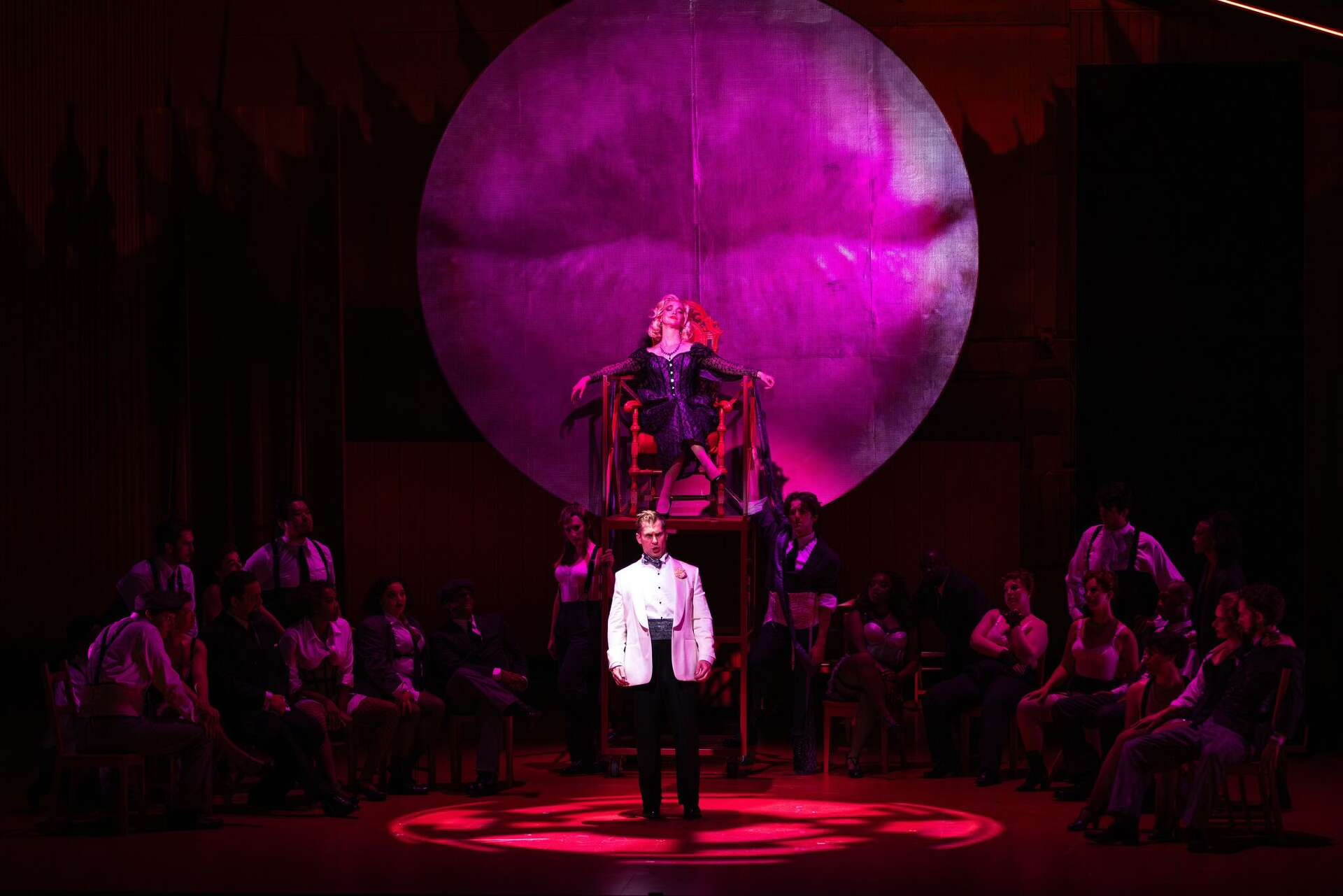
And he made the most of the Alice Busch Theater stage with a red-themed presentation, and simple yet effective scenery, all in constant motion.
Director and Choreographer role was combined. Eric Sean Fogel did a terrific job, especially in scenes like the fast-moving auction comedy, where microsecond timing is vital.
Casting was top notch. Soprano Lydia Grindatto, Anne Truelove, nailed the best aria in the show, the evocative and impossibly high ranging aria No news from Tom. I recently heard Grindatto sing a powerful Neda in Leoncavallo’s Pagliacci in Salt Lake City.
Tom Rakewell was tenor, Adrian Kramer, who is enjoying a brilliant career in Canada, Germany and America. He was especially poignant in assuming the illusion of Adonis in the final scene. He sang with firm authority and a hard-hitting tone.
Other members of the excellent cast are here.
The action: ACT I
In the garden of her father’s country house, Anne Trulove and her fiancé, Tom Rakewell, celebrate springtime. Trulove, who thinks Tom is a loser, has arranged a city job for him. Tom declines the offer.
Alone, he declares his intention to trust his good fortune and enjoy life. He wishes for money. “Poof!”A stranger appears. Nick Shadow. Could that possibly be Satan?
He tells Tom a forgotten uncle has died, leaving him a fortune. Anne and Father Trulove return to hear the good news. Shadow suggests accompanying Tom to London to help settle his affairs. Tom agrees to pay him for his services in a year and a day. Never mind the small print.
As they leave, Tom promises to send for Anne shortly. Cunning Shadow turns to the audience announcing, “The progress of a rake begins.”
Not the best first stop for a country lad, Tom pitches up at a brothel run by Mother Goose. Tom recites the catechism Shadow has taught him to the madam: follow nature rather than rules, seek beauty and pleasure. When asked about love, he thinks of Anne and is momentarily terrified.
He is eager to escape. The clock strikes one, but Shadow turns it back an hour and assures Tom that time is his. Tom responds with reflections on love, which he feels he has betrayed, but then, “what the hell”. He accepts Mother Goose’s offer to spend the night with her. Anne Trulove’s gander is well and truly cooked.
As night falls, Anne wonders why she hasn’t heard from Tom. She leaves her father’s house, determined to find him. The aria, No word from Tom is painfully beautiful.
ACT II
Tom, in his house in the city, is bored already, disillusioned with his decadent life. He dares not think of Anne. Yet another damned wish: this time, for happiness. On cue, Shadow appears and makes an unusual suggestion. He shows him a poster of Baba the Turk, a bearded lady on display at the fair.
Portrayed as a moving image onscreen, Baba, he/she/it/bearded/shaved, raised some inappropriate sniggers from the audience of Glimmers. Shadow suggests Tom marry her to express his freedom and thus know true happiness. Amused, Tom agrees.
Anne comes to Tom’s house, surprised to see servants enter with strangely shaped packages. Tom arrives in a sedan. Startled at the sight of Anne, he declares himself unworthy and tells her to leave and forget him.
Baba calls out, miffed, from the sedan. Tom admits to the astonished Anne that he is married. And to what? Both wonder what might have been, while Baba interrupts with impatient remarks. Anne faces reality and leaves, as a crowd of passers-by hails Baba. Baba is an influencer.
Tom sits sulking while Baba chatters away. Relentlessly vacuous about the personalities she has encountered in her adventures, or maybe not.
When he refuses to respond to her affection, she complains bitterly. Tom silences her, then falls into an exhausted sleep, as Baba remains motionless.
Shadow wheels in a strange machine that seems to turn stones into bread. Worldwide famine will end! In Glimmerglass, the machine was smartly made up of dancers, the whirling actions represented by choreography.
Tom awakes. “I wish it were true”. Stop wishing, Tom! Wow, the machine is what he saw in his dream. Elated, he wonders if in return for one good deed, his Bob Geldof “Save the World” moment, he might again deserve Anne. She may even overlook the close shave with Baba. Shadow points out the device’s usefulness in fooling potential investors.
ACT III
Tom’s business plan has a snafu. No-one buys the stone into bread thing. They had lost a fortune on the bread and fishes guy two millennia before. Ended up being crucified.
Bust. Tom is ruined. His belongings - including Baba, who has remained motionless throughout - are up for auction. As gossiping customers examine the objects, Anne enters looking for Tom. The auctioneer, Sellem, begins to hawk various articles.
When the crowd bids for Baba, she resumes her chatter and, indignant at finding her possessions up for sale, tries to duff up the auctioneer and order everyone out. She advises Anne to find Tom, who still loves her. Baba has a kind side.
Tom and Shadow are heard singing in the street and Anne rushes out after them. Baba makes a dignified exit, off to set up a new Instagram account.
Shadow has led Tom to a graveyard with a freshly dug grave and calls in the promise. The year and a day deadline is up. Payment due. No cash? It’s your soul I want.
Tom must end his life before the stroke of midnight. Suddenly, Shadow offers an alternative: they will gamble for Tom’s soul. Placing his trust in the Queen of Hearts, Tom calls upon Anne as her voice is heard. Wins the three-card game.
The defeated Shadow disappears, but not before he has condemned Tom to insanity. As dawn breaks, Tom imagines himself Adonis, the lover of Venus.
In an insane asylum, Tom awaits his wedding to Venus. The Keeper admits Anne. Believing her to be Venus, Tom confesses his sins, and for a moment Stravinsky suspends time. They imagine endless love in Elysium. Tom asks her to sing him to sleep.
The other inmates are moved by her voice. Father Trulove comes to fetch his daughter, and Anne, realising at last she must move on, bids the sleeping Tom farewell. When he wakes to find her gone, he cries out for Venus as the inmates mourn Adonis.
The Rake’s tale is ended. But Stravinsky rounds off proceedings with an epilogue in the moralistic style of the final sextet in Mozart’s Don Giovanni, or Verdi’s Falstaff ensemble, "Tutto nel mondo è burla". "All the world is a joke".
The principals gather to tell the audience the take-away story. Anne warns that not every man can hope for someone like her to save him; Baba, that all men are mad; Tom, against self-delusion - to Father Trulove’s agreement; Shadow, his impossible role as man’s alter ego. All agree the devil will find work for idle hands to do.
Post-performance, I was sitting in the refreshment garden having a coffee with friends, trying to come down from Stravinsky’s Cloud 9. Maestro Colaneri hove into view, joined us and attempted an unsuccessful effort to descend back to planet earth. Stravinsky had obviously taken him beyond the stratosphere.
He bubbled with enthusiasm. About his orchestra, the cast, the production. No celebration yet. Off for an immediate shower to effect a controlled re-entry. The conductor had given his all.
It seemed almost gratuitous to express enthusiasm. Maestro Colaneri knew Glimmerglass’s The Rake’s Progress had capped this year’s 50-year Festival. And set a high barrier for the 50 yet to come.
Read more from Gerald Malone on The Rest is Opera
