


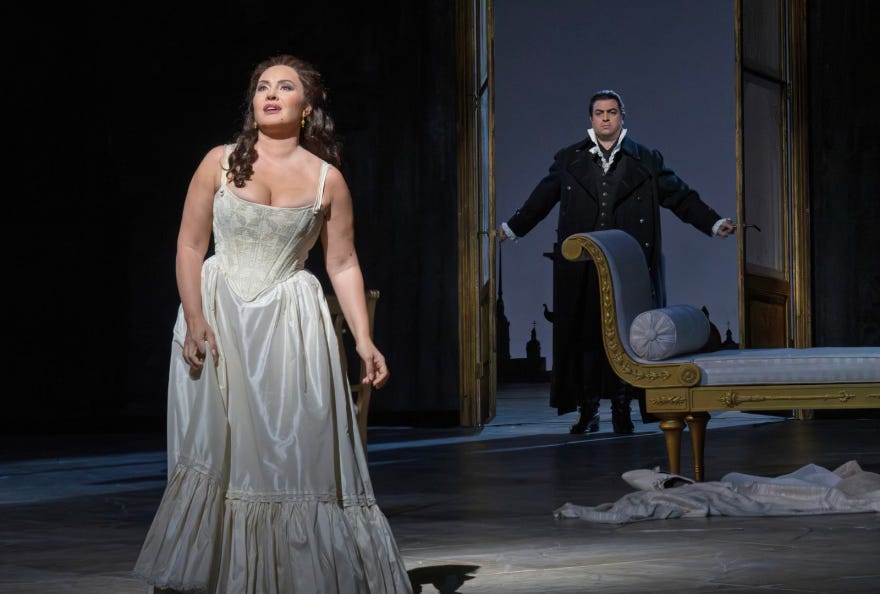
She Came in Through the Bedroom Floor. Nitpicking cognoscenti Beatles fans will insist she came in through the bathroom window.
Motivated by a crush on Paul McCartney, fan Diane Ashley broke into the singer’s St John’s Wood home and departed with looted memorabilia, providing the inspiration for track 13, She Came in Through the Bedroom Window, on The Beatles 1969 album, Abbey Road.
Immortalised by that sleeve, the Fab 4 marching across a pedestrian crossing, minus Belisha beacons. Abbey Road NW8. I preserve my LP in pristine condition. It cost 33 shillings and 6 pence. Halcyon days!
In The Queen of Spades, at New York’s Met this was no humble interloper abusing the stage floor. No demeaning bathroom window for the haughty, hellhound countess at the centre of Tchaikovsky’s opera, knocked off in 44 days in 1889 on a commission for The Imperial Theatres, premiered in the Marinsky, St Petersburg, libretto, by Tchaikovsky frère, Modest.
Shock horror! The ancient, dead, hag – formerly known as The Venus of Paris – had come back to life to haunt the bejeesus out of obsessed Hermann, having a wakeful evening in bed.
He's a soldier and gambler in love with the countess’ granddaughter, Lisa, who had carelessly scared the old bird to death trying to learn a secret.
The secret of the three cards – “tre carte” – with which she had won a gambling fortune back in the Paris days. If he wrung the secret out of her, it would be the making of his.
In one of the most bizarre and dramatic opera entrances I have encountered, Countess Venus burst through the stage floor. “Enter, stage below, preceded by a wig”. With scant consideration for the parquet. Scattering wooden tiles with gay abandon as she punched her way back to life, her emerging spotlit bouffant first evidence of arrival.
Welcome to a Reaction two-opera card combo review. The Queen of Spades, New York. And Pique Dame, Deutsche Oper Berlin. Why twice, in two houses split by an ocean? Because this opera is a thriller, dealing in the dynamics of titanic personal struggle. Love, greed, loyalty, hubris. Seek it out wherever it is performed.
I recommend it to anyone who thinks, “Bish, bosh, opera’s just high falutin’ tosh”. This opera has crowd appeal. The Queen of Spades has been made into two horror movies. A classic 1949 version starring Anton Walbrook and Dame Edith Evans, and a rubbish, teen-scream 2021 offering, starring no-one in particular.
The point is if it’s good enough for the Hollywood treatment, how much better to see a full-on live version – while basking in a superb Tchaikovsky score.
So, what’s the story?
Act I
St. Petersburg, Russia, at the close of the 18th century. In the Summer Park, Sourin and Tchekalinsky discuss the strange behavior of their fellow officer Hermann. He seems obsessed with gambling, watching play, though he never plays himself.
Hermann pitches up with Count Tomsky. He’s in love with a girl whose name he doesn’t know. When Prince Yeletsky enters, followed by his fiancée, Lisa, and her grandmother, the old countess, Hermann’s shocked to realise that Lisa is “the one.”
After Yeletsky and the women have left, Tomsky tells the others the story of the countess. Decades ago in Paris, she won a fortune at the gambling table with the help of the “three cards – tre carte,” a mysterious winning combination. She undertook an illicit bonking mission to learn it from a count.
She only ever shared this secret with two other people, husband and lover. There is a prophecy the countess will die at the hands of a third person who will force the secret from her. The men laugh, except for Hermann, who has a cunning plan, to learn the countess’s secret.
Lisa reflects on her Prince fiancé – worthy but dull - and the impression Hermann has made on her. To her shock, he suddenly appears on the balcony. He boldly declares his love and begs her to have pity on him. Lisa gives in to her feelings and confesses that she loves him too.
Act II
Prince Yeletsky has noticed a change in Lisa’s behavior. During a ball, he assures her of his love. This is the lynchpin aria of the work. Akin to Lensky’s aria in Eugene Onegin. Yeletsky may be a cuckold, but he’s the only honest man in town.
Hermann, milling with the mob, has received a note from Lisa, asking him to meet her. Sourin and Tchekalinsky tease him with remarks about the “tre carte.”
Lisa slips Hermann the key to a garden door that will lead him to her room and through the countess’s bedroom. She says the old lady will not be there the next day. Eager Hermann insists on coming that very night. Fate is handing him the chance to learn the countess’s secret.
In the countess’s bedroom, Hermann looks fascinated at a portrait of her as a young woman. In the Berlin production, there is a silent black and white movie backdrop of the countess’s triumphs in Paris.
He hides as the countess, with retinue, returns from the ball and, reflecting on her youth, falls asleep in an armchair. The reminiscences are of her conquests. A list aria, worthy of Leporello’s keeping score of Don’ Giovanni’s conquests.
She seems to have succumbed to the charms of every entrant in the Almanach de Gotha, a Who’s Who of French aristos. In her day granny was a goer.
Hermann wakes her up demanding to know the secret of the cards. The countess refuses to talk to him, and when Hermann, growing desperate, threatens her with a pistol, she dies of fright. Oops!
Lisa rushes in. Horrified at the sight of her dead grandmother, she realises that Hermann was only interested in the countess’s secret. Not her.
Act III
Hermann is going bonkers. Obsessed with the “tre carte”. In his quarters, he reads a letter from Lisa asking him to meet her at midnight. The girl just doesn’t give up.
He recalls the countess’s funeral, and suddenly, at the Met, the floor tiles scatter as the ghost appears. In Berlin, the countess simply wanders in. A bit lame. Hermann is told he must save Lisa and marry her. His lucky cards will be three, seven, and the ace.
Lisa waits for Hermann by the Winter Canal, wondering if he still loves her. If he doesn’t appear by midnight, she will know he doesn’t care. On the final stroke of the clock Hermann appears.
She says they should leave the city together. Hermann says “Nope!”.
He has learned the secret of the cards and is on his way to the gambling house. Lisa realises she has lost him. Drowns herself in the canal. Or, in Berlin throws herself over a wall – shades of Tosca - and ends up dead on a gambling table. Hmmm!
At the gambling house, the officers are playing cards, joined by Yeletsky, who has broken off his engagement to Lisa. Hermann enters, distracted, and immediately bets 40,000 rubles. He wins on his first two cards, a three and a seven.
Upsetting the others with his maniacal expression, he declares that life is a game. For the final round, he bets on the ace but loses when his card is revealed as the queen of spades.
Horrified, haunted by the countess’s face staring at him from the card, Hermann shoots himself, asking for Yeletsky and Lisa’s forgiveness.
The Met show is a revival of the 1995 Elijah Moshinsky production, a lavish presentation with the Met on full French ballgown throttle. Moshinsky died in 2019. This was one of his finest achievements. The set and costumes by Mark Thompson, famous for West End spectaculars, with a cream and black theme and traditional architecture are joys.
Not often the set gets applause from a cynical Met audience, but this one did.
In Berlin, Deutsche Oper offered a cabaret approach. Directed by Sam Brown, with set design by Stuart Nunn, great use was made of the 1961 theatre’s ability to raise and lower scenery at a whim. Perhaps overuse, as when in a final casino scene, the gambling table was raised from beneath the stage revealing Lisa’s stretched out corpse.
The corpse had not even interrupted play. I suppose a metaphor for the whole Pushkin based plot. Lisa also haunted the final moments of Hermann’s grisly demise. Not sure if that worked. By the time he shoots himself, she’s done and dusted.
Pointless to judge whether New York bested Berlin or vice versa. Each interpretation was perfectly valid. And beautifully executed. Voices in both settings were superb. The Met cast list is here. Deutsche Oper’s here.
Minor gripe. Deutsche Oper’s inability to resist the city’s arty crowd fixation with homoeroticism. Male felatio at the masked ball, crude officers displaying plastic 1 litre bottles as todger extensions. And a gratuitous ensemble of almost naked transgender dancing and acrobatics in the final scene. They just got in the way. But, what the hell? You’re in Berlin.
The Queen of Spades used to be one of Tchaikovsky’s lesser-known works but now seems to be popping up in repertoire far more regularly. Deservedly so. Opera at its enthralling best. Catch it if you can. Whether in New York or Berlin, this thriller will drag even cynical newbies into Pushkin and Tchaikovsky’s haunted world.
