


I was invited to deliver the defence lecture at Newcastle University ten days ago, as part of their public lecture series. As my theme I took the “end of history” period in the 1990s and the way in which the rupture that has taken place since then requires us to transform our thinking about how the world works and the role that should be played by Britain and its allies.
I’m reproducing the lecture here (free to read) with the permission of Dr Martin Farr, who is a leading figure in the field of contemporary history. I have edited it down a little but I hope the essence of the message is clear - the world has changed, there is no room for future Budgets in which defence is not a priority and barely merits a mention, and we need to get our act together, fast.
This weekend, I was in Munich for a dinner connected to the Munich Security Conference. Along the way I was writing the next paid newsletter for loyal subscribers which should land in the next few days. Thank you for your patience.
Eight weeks today it is the London Defence Conference, the fourth edition of the gathering of allies and friends. Our theme for LDC 2026 is Readiness, with a big question implicit in that title: Are we ready?
Here’s the text of my speech from Newcastle.
Thank you for that generous introduction. It is a pleasure and an honour to be here, in one of my favourite cities, and to be invited to speak at a great educational institution by one of the nation’s finest academics in his field - Dr Martin Farr.
In this defence lecture my aim is to examine the arc of history since the end of the Cold War; to chart the effect of the post-Cold War ideology on weakening our defences; to examine the current threat picture and offer some thoughts on how we should think carefully about what comes next.
First, a disclaimer, or an advisory warning. Looking at the news and at the state of the world it is easy to be discouraged. Doing what I do, as director of the London Defence Conference, I am often asked - are we headed for war? Is it inevitable? How bad will it be if or when it happens?
The point here is not to instigate or provoke conflict. This is not about seeking war, which we know looking at history is best avoided whenever possible.
This is about avoiding war, if we can. With the world having become more dangerous, this is about strengthening our defences to create deterrence. To signal to potential adversaries that we have the wherewithal and capabilities to respond as a nation, with our allies, and in doing so to change the risk calculation.
And if deterrence does not work and our adversaries are intent on conflict at any cost? In that unhappy situation by rearming we will give ourselves the best shot at defending our way of life and repelling our adversaries.
This concept is something which was very widely understood across society in the 19th and 20th centuries, until relatively recently. But something changed since the end of the Cold War. What was it?
Understanding contemporary history and applying its lessons is the best place to start our search for an explanation.
Francis Fukuyama’s lost world
We begin in 1989, when a US State department policy adviser, Francis Fukuyama, wrote a paper in which, observing the implosion of the Soviet Union, he claimed that humanity had arrived not only at “the passing of a particular period of post-war history, but the end of history as such: That is, the end-point of mankind’s ideological evolution and the universalization of Western liberal democracy as the final form of human government”.
Three years later, after the formal dissolution of the Soviet Union, he expanded his thesis into a famous and bestselling book, “The End of History and the Last Man.” Fukuyama’s claim was that, with the triumph of liberal democracy over Communism, the Western model had evolved to a peak in human achievement. It could become the dominant form of governance globally. In fairness to Fukuyama, a great scholar, there were many nuances in his thesis that were little reported. And much later - in a defining essay - he deserves credit for being among the first to understand and explain in a clear sighted way the character of the Chinese regime under President Xi.
Nevertheless, his proclamation in the early 1990s of “the end of History”, in an age addicted to soundbites, provided an irresistible catch phrase for academics, politicians and the media.
It is difficult to explain, particularly to younger colleagues, just how much of an impact was made by the end of history theory when it arrived. Media was very different in the early 1990s. Everyone read newspapers and they dominated the debate, setting the terms of reference, and communicating the latest and most accessible academic and strategic thinking. On current affairs discussion programmes on television the end of history and associated thinking were pored over and the politicians of the time took their cue.
Obviously, it was immensely good and cheering news that for us voters lifted the air of paranoia which had permeated politics during the late Cold War. The nuclear nightmare faded.
For the Conservatives in Britain at the time it was an affirmation because the West’s victory in the Cold War was partly Margaret Thatcher’s victory. The Soviet economic system had collapsed under the weight of its own contradictions and the pressure of US defence spending. Deterrence and strong defence had worked, as Thatcher said they would.
For the parties of the centre left who sought a return to power - in the US the Democrats and in Britain Labour - the end of history was also an opportunity. With the Soviet Union defeated, defence would cost less and there would be more for other forms of social spending. Plus the Republicans and Conservatives would be deprived of one of their main campaign messages (the left is too soft on defence) that had worked well throughout the 1980s.
Back then, the end of history concept suited almost everyone. Unfortunately, as we now know, it turned out to be an extravagant indulgence in hubris.
A superficially plausible theory encouraged us to take a holiday from history and to forget that hard power is an essential component of grand strategy, national policy and successful alliances.
Nor was the concept philosophically consistent. The term “the end of History” was not invented by Fukuyama, but by Hegel, the precursor of Marx. The notion that history is evolutionary and has a beginning, a middle and an end was a core Marxist concept. So, in proclaiming that history had ended, Fukuyama was accepting a basic premise of the ideology on whose grave he was dancing.
Nor was Fukuyama’s claim consistent with historical circumstances even at the time he was writing. The Soviet Union, with a population of 290 million, had collapsed; but China, with a population of 1.16 billion, remained Communist.
At the time the dominant assumption, of course, was that as China liberalised its economy and grew - fast - it would automatically come closer to liberal democracy, to our system, becoming a market economy and more democratic and thus posing us no strategic threat.
In the 1990s at the dawn of the end of history it could also have been noted, too, that although the full emergence of radical Islamist militancy lay a decade ahead, there were plenty of warning signs in the late 1980s, particularly in Britain.
Weighed against post-1991 historical experience and current reality, the complacent “They all lived happily ever after” imposition of liberal democracy on a world, the greater half of whose population either rejected or were indifferent to the concept, now seems extravagantly naive. The “happy ending” delusion was abruptly exploded on 11 September 2001, with the terrorist attack on the Trade Center in New York and America’s subsequent wars.
Add to that the Russian Federation’s return to autocracy and the invasion of Ukraine, China’s exponential increase in economic and military power, the continuing pressure from militant Islamism, the weakness of Europe, the culture wars creating fissures throughout Western society and Trump-led America’s disengagement from former geopolitical commitments. In that context, the vision of a universal liberal democracy bringing peace and prosperity to every corner of the planet, on a permanent basis, seems less visionary than hallucinatory.
The Great Western Delusion: “the 1990s peace dividend’’
Maintaining Western defences at a level to deter Soviet aggression during the Cold War had put a strain on the finances of NATO member states and other nations with security concerns. The ending of the Cold War, therefore, brought a collective sigh of relief from countries that believed they were now at liberty to devote more of their national budgets to projects such as infrastructure, investment and welfare.
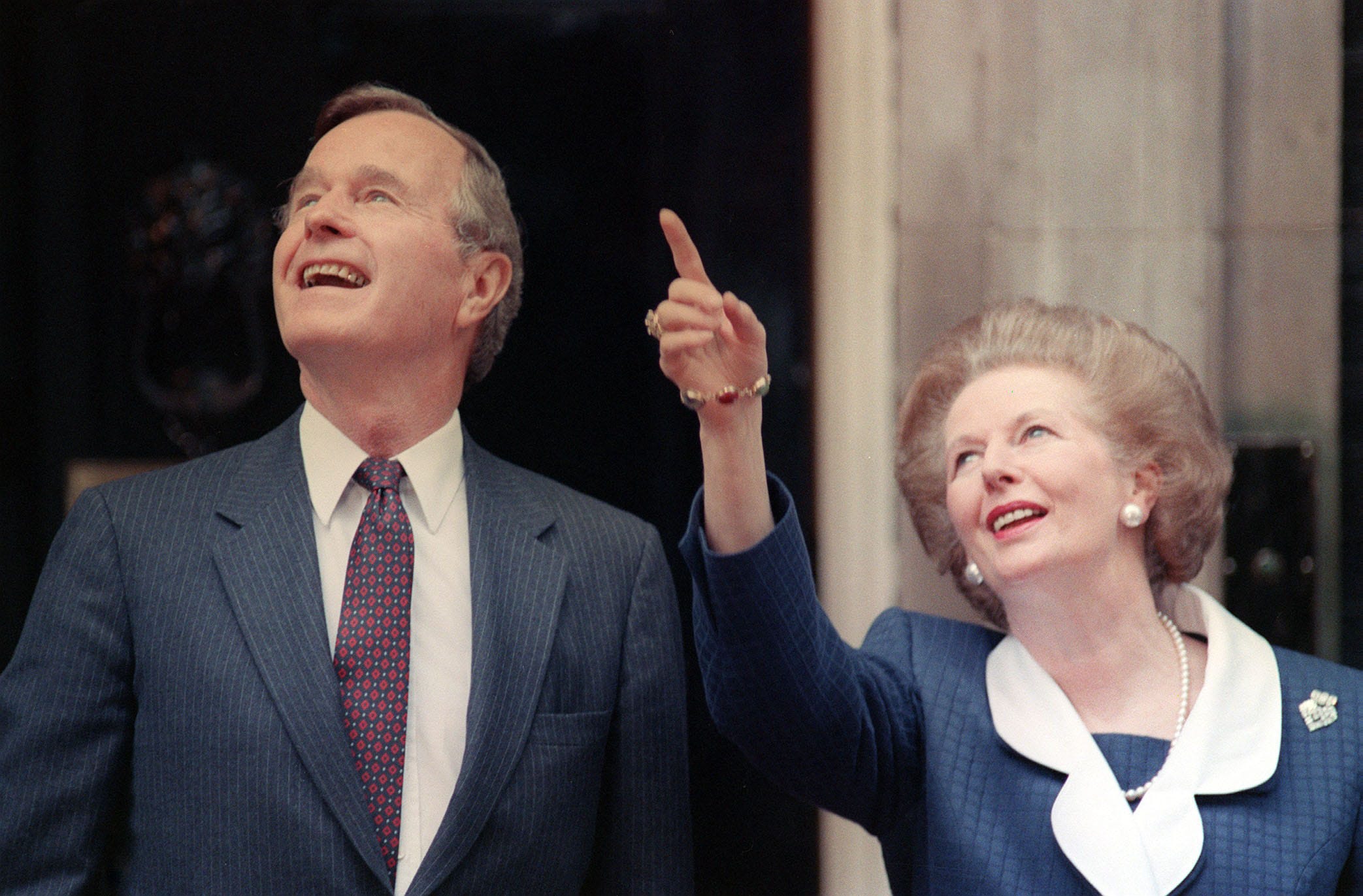
The term “The Peace Dividend” was coined by U.S. President George H W Bush and the outgoing UK Prime Minister Margaret Thatcher to describe this opportunity for a new allocation of government expenditure.
Although the notion of the “peace dividend” now seems naive, even delusional, at the time it was an understandable reaction to a post-Cold War situation, and as I mentioned earlier we should not underplay the psychologically liberating sensation of relief at what was believed to be the removal of the threat of nuclear annihilation. When the Soviet Union dissolved, the newly sovereign state of Ukraine unilaterally renounced its nuclear weapons; the newly created Russian Federation did not.
The lure of the peace dividend was strongest in Western Europe. In 1989, the average NATO member state’s expenditure on defence was 4% of GDP; by 2014, the year of Russia’s annexation of the Crimea, that figure had fallen to 1.4%. Such drastic reductions meant not only that European NATO members were no longer increasing their defence capacities, they were also running down their armaments and equipment, sometimes on an extravagant scale.
Some countries abolished conscription, though others were more cautious and robust. Most robust was hardheaded and sensible Finland, a close neighbour of Russia with experience of aggression from its eastern neighbour. It not only retained conscription, it also took advantage of Western thinking to buy Leopard tanks from the Netherlands, which ran down its tank force. Yet even Finland reduced its defence budget to below the 2% of GDP level in the post-Cold War years.
Overall, during the 30 years following the collapse of the Soviet Union, the “peace dividend” channelled an estimated total of €4.2 trillion to non-defence spending across Europe.
Britain embraces the peace dividend
The United Kingdom was no laggard in recalibrating public spending away from defence to other objects. The trajectory of British defence spending declined from almost 8% of GDP in the mid-1950s to 4% by 1980 (still in the Cold War era), heading towards 3% in 1990 as the Soviet Union was defeated.
Britain’s experience was unusual among the European allies in that after 2001 it not only answered the NATO call in Afghanistan, but it also joined the US war in Iraq to remove Saddam Hussein. Perhaps it was that experience - the terrible human cost abroad combined with the shock of the financial crisis at home reducing the funds available - that meant after 2010 we the public were reluctant to do more on defence. We wanted more spent on our welfare rather than more spent on war-fighting capability, which had failed in Iraq.
Today our defence spending stands at about 2.5%, four years after Russia’s full-scale invasion of Ukraine. Within that is roughly 0.7% of GDP for the nuclear enterprise, providing Britain’s deterrent which is operationally independent but closely connected to the US in logistical terms.
Remember the broader context. Spending on the NHS soared from 3% of GDP in the mid-1950s rising to more than 7% in the 2000s as expectations and medical progress made their impact.
During the pandemic, spending on the NHS hit over 10% of GDP, 12% of GDP in total for healthcare including private provision, and has fallen back a little since. Then there is welfare - taking in pensions and all benefits. That is is equivalent to another 10.6% of GDP or 23.6% of the total amount the government spends.
In context, today, Britain’s total welfare budget for 2025-2026 is estimated at £334bn, while the defence budget amounts to £62.2bn. That is just £14bn more spent on defence than was spent in 2014-2015, when Russia annexed the Crimea.
At the NATO summit last July, Britain was among those committing to 5% of GDP on defence after pressure from President Trump. That is 5% made up of 3.5% on core defence spending and another 1.5% on resilience.
Britain was chief among those making the commitment to the Americans. We await news on how it will happen. The government wants to increase defence spending to 3% in the next parliament, which means sometime between 2029 and 2034, meaning we may not hit 3% properly for perhaps eight years, a period as long as the Second World War, plus two years.
Mind you, speaking of the next parliament, if events at Westminster continue on their current trajectory, the next election and the next Parliament could be a lot closer than 2029. Who knows what the next few weeks will bring.
The imperative to increase defence spending fast should be obvious
There is a clear danger to Britain’s security in failing to maintain credible defences to deter the two main potential aggressors: Russia and China.
But there is a more immediate challenge from another quarter: the development of United States policy. The US has been urging Britain and its other European allies for the past 10 years and more to increase defence spending, instead of relying on the American armed forces – and ultimately the American taxpayer – to supply an unending guarantee of security, while Britain and EU states devote expenditure instead to social projects.
The language may be undiplomatic in ways that we Europeans find distasteful, on Greenland, for example; but the Americans are right to warn NATO members that we must step up.
Indeed, history shows us the American focus on this is not new. As far back as the late 1950s, President Eisenhower asked privately when Europe would be able to take care of itself so America could “go home”. In the 1960s his successor JFK asked similar frustrated questions about NATO commitments.
The good news is that as some - some - European defence budgets demonstrate, a decade of warnings from Trump is galvanising key states in Europe.
Poland - increasingly the essential European nation - is on track to spend 4.8% of GDP on defence this year. Germany is increasing its spending dramatically - up from 86 billion euros last year to 108 billion euro this year.
Still, it may not be enough. Not everyone is increasing spending as fast as the Poles and a future US administration may decide to go further and draw down forces from Europe. As it stands, the European pillar of NATO is heavily dependent on US capabilities - in terms of heavy lift, the ability to move troops around fast, and in intelligence and targeting.
Now, in the second Trump term, that deep and still smouldering American resentment with Europe is aggravated by a radical recalibration of American security policy away from Europe, and towards the Indo-Pacific theatre. Most of all there is a focus on a re-energised Monroe Doctrine impelling the United States to defend the homeland and reassert its influence in its neighbourhood in central and South America. In this climate, NATO has inevitably fallen down the list of American defence priorities.
Marco Rubio, U.S. Secretary of State, is the latest major player to express the administration’s frustration with the conduct of its European allies. Appearing before the Senate foreign relations committee earlier this year, the Secretary of State said that NATO needed to be reimagined. “The reason why it has to be reimagined is not because its purpose is reimagined,” he said, “its capabilities have to be reimagined.” He denounced rich European nations for channelling money into social programmes, instead of increasing defence spending, because they thought the United States would come to their defence in a time of need.
“Security guarantees basically involve the deployment of a handful of European troops, primarily French and UK, and then a U.S. backstop,” he claimed. He stated that some European states’ proposal to put troops into a post-war Ukraine in the event of a future peace plan was “irrelevant without the U.S. backstop”. The degree of disillusionment being voiced by the US Secretary of State suggests that America will - rightly - want more than vague promises of 5% by the middle of the next decade.
We have seen the impact of our underspending. The former defence secretary Ben Wallace said that governments of both parties - both parties, he stressed - had hollowed out our armed forces. Now, the holiday from history is over and they must be replenished.
But what is it all for? What and where are the threats?
The threat environment
It is incumbent on those of us who think that there is a great danger ahead to pause for a moment and with humility acknowledge the risk of war hysteria. Especially after a period of 15 years and more when our leadership class has got this so wrong, and when there is an obvious need to rearm, it is important to consider history and in doing so strive to keep our heads. It is important we get the balance right between caution and action.
In Niall Ferguson’s classic account of the First World War - the Pity of War - there is a defining passage describing and analysing the rush to war. The historians among you will be familiar with the arguments. Was it inevitable once the railway timetables got going and the men and machinery were moved into position? Or was it the disastrous system of alliances?
Ultimately, it appears Britain most feared the rise of Russia in the late 19th century. No country was industrialising at the same scale and at such speed. Britain chose alliances with Russia and France because longterm it feared Russia more than Germany. Thus helping to create the conditions for the miscalculations of the July 1914 crisis and the calamitous war that followed.
Then there is the role of stupidity and the climate created by the Kaiser and others. And the role of ultra-patriotic mindless jingoism here and elsewhere.
In the end it came down to the flawed judgments of human beings operating without the benefit of hindsight.
The lesson today is to try to define threats as calmly and realistically as we can. There the period 2001-2003 comes to mind, when post 9/11 an understandable hysteria took hold. Legitimate concerns over weapons of mass destruction, ending up in the hands of rogue states or Islamist terrorists bent on Armageddon, became distorted and disastrous judgment calls were made. Like many people at the time, I was in favour of the invasion.
Today, Russia is weakened from its failed illegal war in Ukraine where it has lost 1.2m men either killed, wounded or missing in action. Although it has built a war economy, the rearmament being undertaken fast by the Poles and the Baltic States and Nordics means that any invading army would meet resistance. Some strategists conclude the Russians would be unlikely to get very far, given the manner in which they have been held back in Ukraine.
Against that, those who are bullish should recognise that even future incursions by Russia into other parts of Europe, that are subsequently beaten back, would still be very costly in terms of the human toll and the damage done to our economies and infrastructure.
Beyond that what we face is a rolling threat over decades combining the risk of incursions, grey zone hybrid warfare, sabotage, and drone and hypersonic warfare, running through northern Europe but likely originating in the High North, by a Russia backed by China.
Indeed, perhaps the most significant feature of the Ukraine war - aside from the technological acceleration in warfare - is that China has emerged as the main supporter of Russia, a development that would have been thought implausible even a decade ago.
Their alliance means we’re faced with a classic danger that will be familiar to admirers of the work of the great Halford Mackinder, the father of geopolitics. For Mackinder it was all about the “heartland,” the Eurasian landmass - control that, control the world and its shipping routes and the flow of trade and ideas.
At the heart of our challenge is the alliance between two giant countries sitting at the heart of that Eurasian landmass - Russia and its much bigger brother China.
The central strategic challenge: China
China, the aspiring global hegemon, is the challenge that every other nation on the planet must make provision to contain. Nothing could more discredit the “end of history” delusion than the current reality that 1.4 billion Chinese live under totalitarian rule, 35 years after the collapse of the Soviet Union.
In a groundbreaking essay for the American Interest published in 2020, Fukuyama put it well when he said: “To understand how the United States and other Western countries should deal with China in the coming years, we need to understand what kind of society we are dealing with.”
Our hope during the “end of history” era was that China - having moved from totalitarianism under Mao to authoritarianism under his successors, with markets liberalised to a degree - would next become more politically liberal. Evolving, from totalitarianism, to authoritarianism, to the Western liberalism of the end of history period.
It didn’t happen. It took the West a while to realise it, and some in our political system still cannot grasp it, but XI represented a move back to totalitarianism, only this time the party has technology sufficient to exert complete control that was beyond even Mao’s grasp.
As Fukuyama put it from an American perspective: “What Americans need to keep in mind is that their enemy and rival right now is not China, but a Chinese Communist Party that has shifted into high-totalitarian mode. We are not dealing with the China of the 1990s or even the 2000s, but a completely different animal that represents a clear challenge to our democratic values. We need to hold it at bay until some point in the future when it returns to being a more normal authoritarian country, or indeed is on its way to being a liberal country. That will not necessarily eliminate the challenge that China represents; a more liberal China could easily be more nationalistic. But it will nonetheless be easier to deal with in many ways.”
In Xi Jinping’s China, we are facing a totalitarian power structure based on the attempted brainwashing of its subjects, even if Xi’s ideology is a more banal Chinese nationalism rather than Mao’s crazed, violent radicalism. Still, in Chinese Communist ideology, contemporary China is living through “The New Era”. That term is an abbreviation of “Xi Jinping Thought on Socialism with Chinese Characteristics for a New Era”. This derives from the Chinese Communist Party’s formal History Resolution of 2021, the most recent of only three passed since 1949, which canonised, in secular terms, the five paramount leaders of the People’s Republic, beginning with Mao Zedong and ending with Xi Jinping, whose era began in 2012.
This placed Xi on the same level as Mao, giving him extreme authority, for which the way had already been paved by the abolition of limits on a presidential term in 2018. The expectation is that Xi will lead China to new heights of global power, a trajectory that must surely include the reincorporation of Taiwan into the Chinese state at some point, destabilising the Indo-Pacific.
Despite what we are told, China is not a great economic opportunity for us. China is an economic opportunity for China as it seeks to become the dominant civilisation. It is not going to open its markets any further to outsiders and it is not a major mainstream investor in the British economy, and will not become one. The Chinese Communist Party’s goal is to become the dominant exporter of everything, for ever.
China has pursued such goals with great tenacity and skill, first by converting itself into the workshop of the world through its vast supply of cheap labour, promoting the de-industrialisation of the West in the process, while pursuing its own de facto colonialist projects through its Belt and Road initiative. But that project has had mixed results, with some African nations rejecting Beijing’s interventions amid growing mistrust.
Most seriously, China is facing a major demographic crisis that partly may reflect a global population slump, but must surely also be a consequence of China’s disastrous one-child policy. Since male children were preferred to female under that social engineering experiment, there is a huge disparity between the young female and male populations, leaving hundreds of millions of young men unable to find a wife or to cultivate the domesticity that accompanies marriage.
A discontented urban population of male youths is a destabilising factor in society and even a potential threat to the regime. Last year, China’s population fell for the fourth consecutive year. UN estimates suggest the population will fall to 1.2 billion by 2050, bringing all the problems associated with an ageing demography.
But, for the West, the most urgent priority is to assess the military potential of the People’s Liberation Army. On paper it is formidable. China’s regular army is 2,035,000 strong, with 510,000 reservists and a further 500,000 personnel categorised as paramilitary. Unlike the Russian forces, however, it has not been blooded and is lacking in war experience. More sinister than that, from Xi’s point of view, is the deep-seated corruption that reportedly pervades the PLA.
Its Rocket Forces, for example, were found two years ago to have constructed missiles made of too heavy a material for effective launching and some missiles were filled with water instead of fuel. Of the corruption in the PLA, a former CIA analyst commented: “In its scope and scale, it’s breathtaking.” An earlier Chinese leader Deng Xiaoping had encouraged the PLA to engage in commercial activities. That led to widespread corrupt operations, including running dance troupes and high-end hotels. Even Xi, despite his recent purge of the military, is believed privately to acknowledge that the vast network of corruption within the PLA is too deep-seated to be eliminated.
Nevertheless, the only commander to survive Xi’s recent purge of the Central Military Commission (CMC) was Zhang Shenmin, the anti-corruption watchdog. At the same time, it is likely that Xi’s purge had less to do with uprooting corrupt practices than with assuming even closer control of the PLA. Between now and the next party congress, he can pack the CMC with his own choices.
What should we do?
Plainly, the burden of responding on China falls mainly to the US. The drawing away from Europe, and the understandable insistence that Europe should be able to handle most of its own conventional (and perhaps more) defence, compels us to rethink.
There is some good news on that front.
We are not starting from scratch in Europe when we have NATO, which is still the bedrock of Western defence.
The key fact Western policymakers need to bear in mind is that, for Britain and Europe, it is the most realistic current vehicle for collective security is NATO.
Throughout the tensions of the Cold War (including several accidental near misses at nuclear conflict) it maintained Western security competently and effectively. It has proved its worth. It is not obsolescent or struggling, except insofar as some member states lack financial commitment to the alliance. It is unlikely that even America’s current pivot eastwards would have led the White House to consider NATO membership dispensable, had it not been preceded by a decade and more of some member states defaulting on their obligations.
While the threat of withdrawal of the American defence umbrella makes it necessary for Britain and the EU to ramp up provision for their own defence, in the first instance this should be executed in the context of a reinvigorated NATO.
The European pillar of NATO exists as a concept and it is perfectly plausible that non-US members of NATO could do more to replace American capability as it reduces deployments - it will take time though.
Elsewhere, vague political talk, by politicians who have spent their careers ignoring defence, of an EU army as an alternative security guarantee is delusory. It would take many years to devise such a project and the rivalry and disharmony that accompanies such initiatives, mean an EU army is not a realistic defence prospect.
It may be canvassed under alluring soundbites about “standing on our own feet”, “coming out from under the shadow of America”, etc, but it would lack the strategic capabilities that only the superpower America can supply, as well as the magnified deterrence power of a US presence.
Remember, European nations have a too often unconnected variety of weaponry that defies reduction to integrated coherence. It is a Holy Roman Empire of nation-based defence procurement that already poses problems in the context of NATO, problems that would become insuperable in the context of fabricating a putative European army.
Bureaucracy and regulation would further impede the creation of a putative EU army. Britain would be largely excluded and exploited, allowed only to participate in weapons procurement, with large costs for market access, and without taking part in the decision-making processes.
But there is more good news - NATO is modernising.
The organisation is seriously addressing improvements in its capabilities. Its eastern-flank multinational battle groups are being enlarged to brigade level. Additionally, in a return to Cold War strategy, certain national forces are being assigned to secure specific geographical regions. While such measures are important primarily for the defence of Europe, they are also calculated to reassure Washington. The recently published US National Defense Strategy confirms that America remains committed to providing critical support to Europe, though on a more limited scale than before.
That leaves it to Britain and European NATO members to make up the deficit, which they are perfectly able to do if there is the political will, thus securing the future of NATO and the American security commitment, solely at the price of increasing their defence spending to 5% of GDP, a reasonable expectation.
Frontline nations such as Poland, Finland, Sweden and the Baltic States are becoming NATO’s spearhead. They are moving into a high state of military readiness and can become the core force on NATO’s eastern flank. In one likely scenario, they could create densely fortified land frontiers, defended by extensive minefields and a ‘drone cordon sanitaire’, reinforced by large artillery and missile concentrations. NATO thinking is flexible, but focused and creative, significantly informed by observation and analysis of developments in the Ukraine war, where the Ukrainians have impressively pioneered pragmatic and imaginative responses to challenges created by a more heavily armed invader.
Britain’s role and the need for hard power
The first and most obvious conclusion from the developments I have described - a multi-decade challenge flowing from a resentful, revanchist Russia backed by a totalitarian China seeking dominion - is that we have to change the way we think. Not only do defence and national security need to take up a much larger share of our attention and spending. Regenerated manufacturing, much cheaper energy (the core requirement for economic expansion) and much bigger defence industrial capacity are going to be needed.
We need to rearm and reorientate our politics so that more of our leadership class becomes familiar once again with the need to think in terms of grand strategy, security and alliances rooted in hard power rather than rhetoric.
In essence, and this cuts across all political parties, our entire political economy, statecraft and mindset somehow needs rethinking.
In the era since the end of history was declared most of our leaders forgot the indispensability of hard power, and most voters were happy not to think about it either.
That means us getting our act together fast and the UK Treasury being forced to follow through on pledges made by the Defence Secretary John Healey to fulfil the commitments signed up to at the NATO summit in 2025 - namely getting to 5%. At the heart of it we have to rebuild our defence industrial base, as must the rest of Europe, alongside consolidating and modernising the European pillar of NATO.
But there are also other highly useful alliances that overlap. That includes the Joint Expeditionary Force, established by Britain with nine other members, it forms an embryonic Northern Alliance defending the Baltic and the High North, stretching into the Arctic.
The links with Australia, through the AUKUS partnership and beyond, are strong and growing. And Japan will be an increasingly essential ally.
The myth is that we can consider this in European isolation, because we are a middle power. In reality, as Mackinder showed - it is all connected. The High North connects to the Arctic, where China has an interest. The Indo-Pacific begins only 120 miles from the Med, at the foot of the Suez Canal.
It is in our interests for the sea lanes that carry trade to stay open and not be controlled by the autocrats. Ditto with the global financial system. In alliance with other democracies, Britain has a vital role to play.
In playing our part we will only be taken seriously by the United States and by our other allies if as a society we take our defence more seriously and invest. And we will only be able to deter the autocrats if we take our defence more seriously.
Our defences have been neglected and run down for too long by governments of all the main parties. If we cannot see what Ukraine means, that it changes everything, we do not deserve to survive as a democracy. Freedom is the one amenity that is never free. If it means tightening our belts, trimming our welfare budget and making other fiscal sacrifices, that is the price to be paid for retaining the sovereign liberty won by the endurance of two world wars and countless other conflicts.
History has not ended. A competent defence and security system - true hard power - is the sole guarantee that we will continue to help shape history, rather than ending up as its victims.
So glad you're back posting here. We missed you.
Cita and Irwin Stelzer
Just to let people know that the lecture is also on YouTube at the following link:
https://www.youtube.com/watch?v=puYm6P-MTWg