


A dying habit – sometimes mercifully – is the British tendency to work Monty Python into everyday conversation at any opportunity. There are brief flare-ups, of course. At the height of the transgender wars, Life of Brian’s Stan – who wanted to be Loretta – was still being wheeled out as John Cleese’s Reg chided him for “wanting to have babies”.
“Where’s the foetus going to gestate? Are you going to keep it in a box?”
Which rather proves there’s nothing new under the sun – even if, at the time, it was the comedy of the absurd.
And talking of cardboard boxes, anyone caught overstating the poverty of childhood is still met with the line of self-made northerners claiming living in one was “luxury”.
But what was once endemic in national life has, like plague, declined to the point of near extinction.
Showing the strain still lingers, however, is the fact that I thought of Monty Python the other day as I scrolled the pages of His Majesty’s Daily Telegraph – a term I’ve used since spotting a picture of the monarch reading the print edition in the state carriage in Charles Moore’s office.
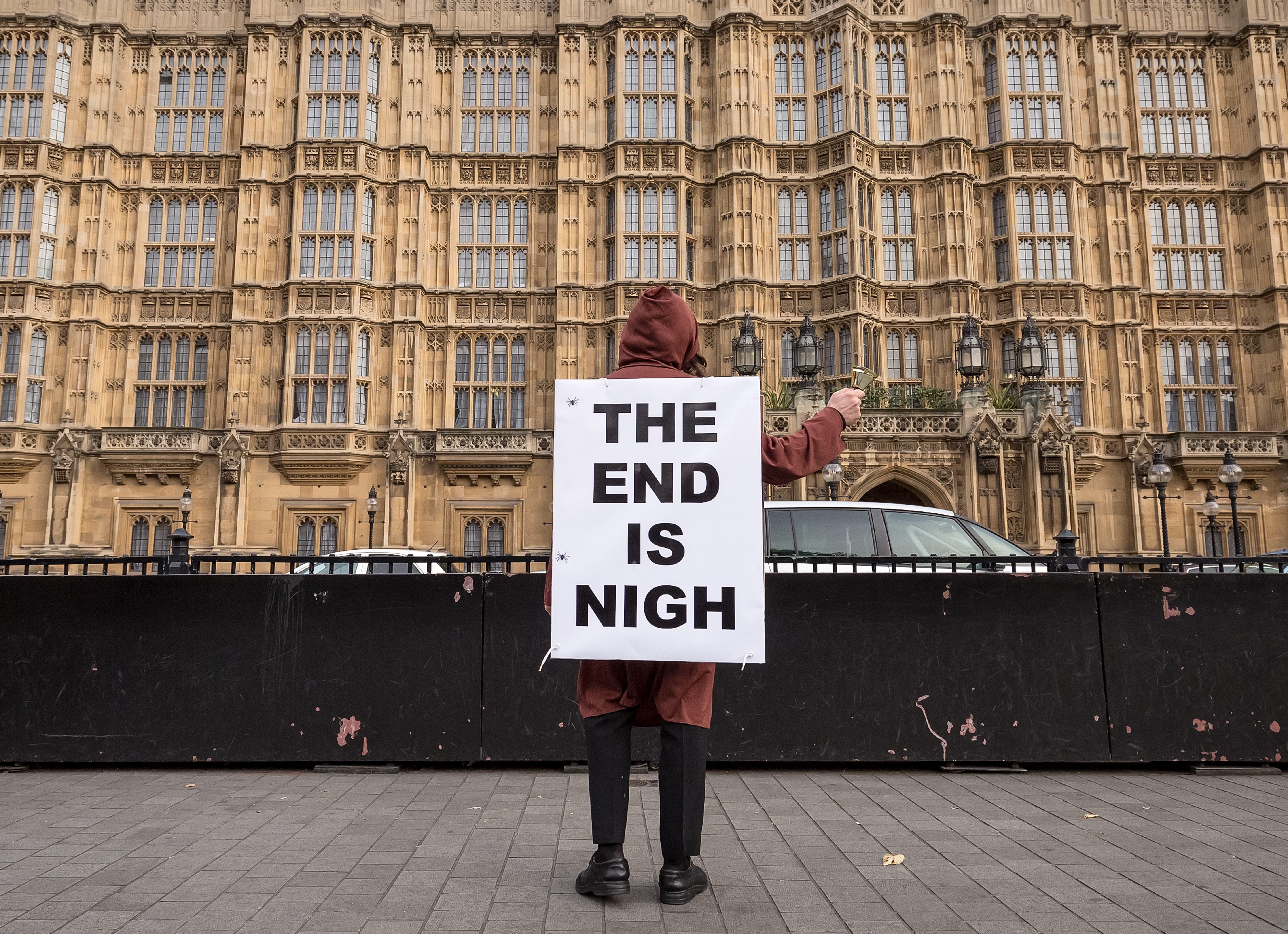
Fans of Life of Brian will remember Jerusalem’s Speaker’s Corner of prophets, each competing to conjure the most grotesque visions of imminent doom. Cynical passers-by lapped it up as local colour while anyone attempting a moderate view of what Jehovah had in store was booed from their makeshift platforms.
Each day, the Telegraph can match it. Columnist after columnist points his or her bony finger at us and, with messianic fervour, warns us like the Ancient Mariner that we must take heed or Britain pays. Ambrose Evans-Pritchard has been predicting economic apocalypse for so long that, like that supervolcano under Yellowstone, it must surely one day go up – it’s already millions of years overdue.
To a point, one can easily accept this as the black addiction to which most journalists are prey. A focus on the day of judgement while the rest of the world largely nods along with it as “what they do”, not taking their bleak prognostications entirely seriously.
I do it myself. Trying constantly to shake the feeling that there is an increasingly obvious accumulative truth to what they’re saying – while finding it doesn’t quite square with observable day-to-day life.
Of course, there are signs. Getting ahead is increasingly difficult. The roads are shocking – pockmarked by abandoned excavations and overburdened. I trust the judgement of the police decreasingly and to the point that, when they screech by, there seems something performative to it. “Off-colour tweet! Request immediate backup!”
Pubs are closing. Eating out has become an exercise in overpriced mediocrity. Life can be joyless.
But, like the Telegraph itself, there’s never a shortage of attractive alternative viewpoints. Twenty undiscovered Greek islands about to be ruined by this article. Expensive car reviews. A modern man’s guide to stylish swimwear. All reassuringly insouciant. Reassuringly middle class in their preoccupations and all replete with the internal contradiction of “how to boost your cash ISA” while simultaneously predicting global fiscal catastrophe.
I try too to put things in historical perspective. It is by no means the first time in my life that the world has seemed bleak in outlook. America was at war in Vietnam throughout my childhood. Israel and the Arab world went at it hammer and tongs repeatedly. Energy was in crisis with queues at the petrol stations and lights going out.
Russia lurked just across the Iron Curtain and then invaded Afghanistan. Nuclear proliferation was punk-lampooned by Not The Nine O’Clock News in their “seminal” All Out Superpower Confrontation and Britain’s economics have lurched between the gross incompetence of the 70s, the triumphs of the 80s, the Black Wednesdays of the early 90s and the “prudence” of the Gordon Brown years.
We have, collectively, lived with the “Loony Left” before as well. Red Ken and his Corbyn-like love of all shades terrorist – from the PIRA to the PLO – and his notably off-colour views on Jewishness.
That it is striking doctors rather than striking miners that now blight the national effort is only a reflection of the national shift from the blue to the white collar. Same shit, different decade.
Meanwhile, an intransigent civil service at the ostensible service of craven politicians was parodied across a decade in the 80s sitcoms Yes Minister and Yes, Prime Minister. Jim Hacker’s crusade against government waste still goes on or, more likely, still sits on Sir Humphrey’s desk waiting to be dealt with “in the fullness of time.”
In another comic continuity, the police were also in the line of fire – with Gryff Rhys Jones stood bone-headed before Rowan Atkinson’s dressing down as Constable Savage, the bigoted black-basher of the Special Patrol Group.
And as civil unrest unfurls across the country, The Smiths got there first, singing: “Panic in the streets of London, panic on the streets of Birmingham…”
Even the state of the roads has its echoes. Remember John Major and his cones hotline? Yes, perhaps the only thing about his administration that one does remember. That and David Mellor’s Chelsea kit.
So it would be easy to conclude that, whatever the Telegraph thinks, it was ever thus. Life’s rich tapestry. A contextual rollercoaster of ups and downs, catastrophe ever at our shoulder but rarely materialising in its extreme manifestation and generally greeted, as Britain was once wont to do, with a lightly cynical humour. Triumph and disaster treated as Kipling urged, as twin impostors, just the same.
But here’s the difference – and it matters: This time, there is no one left to believe in.
Not really. Not in the way that matters.
The rituals and roles remain – the Cabinet reshuffles, the Select Committees, the breathless radio interviews outside Portcullis House – but the conviction has drained away. Today’s political class is marked neither by ideology nor even pragmatism, but by a kind of managerial fatalism: the sense that real decisions are impossible, that power lies elsewhere, and that success consists not in action, but in avoidance.
You can see it in the outsourcing of hard choices – to lawyers, to regulators, to the markets, to “the science.” You can feel it in the way immigration policy lurches between legal blockages and moral squeamishness; how economic strategy is forever at the mercy of what “the markets” might tolerate; and how even the most basic functions of state – law, order, borders, infrastructure – seem beyond its grasp.
And while in past decades, our national neuroses were at least tempered by a shared culture – often built, strangely, on the scaffolding of humour – that too has eroded. The old reflex to laugh first and rage later has been replaced by a new kind of brittle earnestness, where everyone is forever offended or afraid, and satire risks being mistaken for sedition.
In this vacuum of purpose, the Telegraph prophets have become our new soothsayers – preaching doom not as warning, but as background noise. We are so over-exposed to the language of collapse that we no longer notice the real thing creeping in: the slow institutional rot, the decay of public trust, the nagging suspicion that no one, anywhere, is driving the boat. Except perhaps a people smuggler.
So yes, it was ever thus – and yet, no, it wasn’t. Not quite like this. Because what’s new is not the chaos. It’s the absence of anyone meaningfully trying to master it. Not the loss of control, but the shrug that comes with it. Not the noise of decline, but the silence of resignation.
That’s the real national emergency – the quiet one. The one with no sirens.
But somewhere between Stan wanting to be Loretta and Sir Humphrey stalling on waste reduction, there was a country capable of serious disagreement, laced with seriousness. I hope to God it still is.

This is really very thought-provoking. I can remember those past events and there is definitely something in the idea that we have lost the confidence to change things. A great shame.