


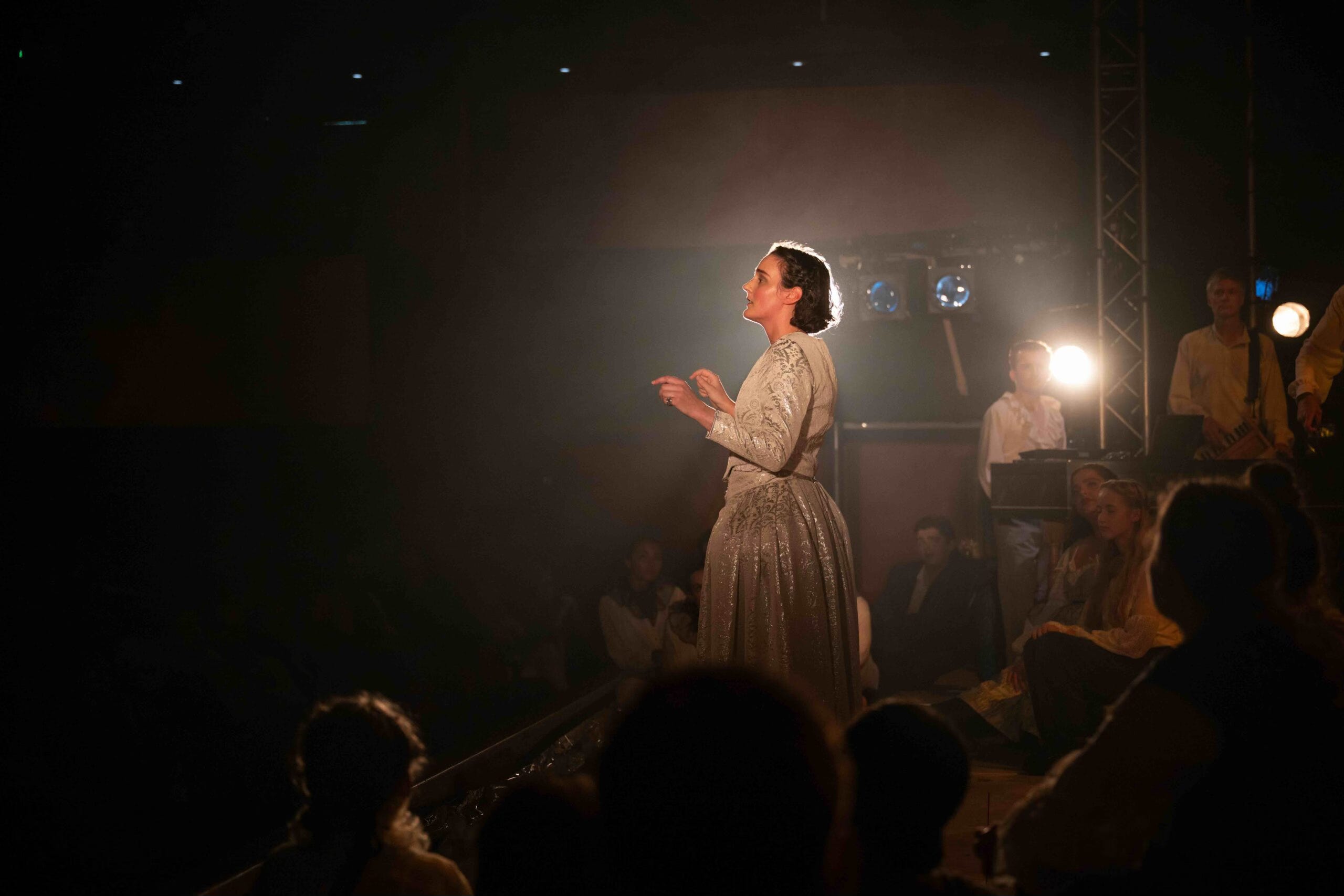
“Sing-Along-A-Dido”! Henry Purcell on steroids. Time to bulk up. His 1684 opera Dido and Aeneas, the first ever British opera, may be a wondrous artistic creation, closing with Dido’s Lament, a cert for a top ten rating in any Weepy of the Year competition. Snafu. It isn’t very long.
In conventional productions audiences are wringing out their hankies, heading for the exits and ordering shedloads of antidepressant Prozac from their favourite online pharmacist on their mobiles a mere 70 minutes after curtain-up.
As Longborough Festival Opera’s dinner interval is 90 minutes, and the return drive from London to the Cotswold haven takes 380 minutes, something had to be done to make the trip worthwhile.
Artistic Director Polly Graham’s solution was to take the Purcell favourite for an extended work-out on a strict sea shanty/traditional ballad diet, strap on a leg brace or two of arias from King Arthur, a Purcell semi-opera, and let the audience loose in the car park only after an extended counselling session - a thrumming musical Wake – post Dido’s death. Spoiler alert. She dies.
The Polly purpose was to create a Restoration masque not just for the audience’s entertainment. We were all invited in as participants. In the shanty Haul Away Joe, Steven Player, an all-singing and tap-dancing member of the ensemble Barokksolistene providing the music, rehearsed the audience in their chorus lines, punctuated with frequent abrupt, loud shouts of, “Hoo!”
Initially demure, serving up only genteel, sappy “Hooooos!” Player whipped up audience enthusiasm and was eventually rewarded with the blood curdling, percussive, shouted “Hoos!” he cheerily demanded.
When Dido movingly breathed her last, the phrases in Purcell’s music fading gently to oblivion with her voice, and the cast and chorus surrounding her lying down in silent respect, the stage lights dimming, the stunned audience burst into a roar of appreciation.
As they cheered the curtain call, astonishment. The supertitle screen suddenly burst in to life announcing, “There is more!!” And we were off to the Wake.
But, before that a word from the necessary Department of Explanation. Graham had decided to dispense with an orchestra. Not even a pit in sight. I hear rumblings from traditionalist readers that this is bold, perhaps a step too far for any Artistic Director? “Phooey! What’s next? Singers?”
Truth is, Longborough’s Artistic Director had long hankered after an opportunity to invite Barokksolistene. The ensemble was founded by Norwegian violinist, Bjarte Eike in 2005. Since, they have become recognised as one of the most exciting, if unconventional groups working in the well tilled field of historically informed performance.
Their ability to fuse musicianship, dance, story-telling and adroit improvisation made them the ideal choice to recreate a Restoration Masque centred on Purcell’s Dido. Less formally known as “The Alehouse Boys” how would they cope against the strength of a traditional Baroque orchestra?
With dazzling musicianship, verve, artistic commitment and sheer joie de vivre that transformed Graham’s dream to a stunning reality. That’s how.
Bjarte Eike, Music Director; Hans Knut Sveen, Cembalo (Harpsichord); Per Buhre, Viola; Thor-Harald Johnsen, Guitar; Flora Curzon, Violin; Judith Maria Blomsterberg, Cello; Michaela Antalová, Percussion and Steven Player, Tap-dancer extraordinaire and occasionally assuming the silent role of villain of the piece, King Iarbas.
Every member of the ensemble deserves a shout out. They were constantly onstage. Throughout, they performed without a sheet of music. They danced, often separately, but never without losing eye contact with Eike whose direction was discreet.
Even the Cembalist danced occasionally – some achievement – and seemed to have found a handheld cembalo to sustain him through the more vigorous passages.
Their tone was bright and more than sufficient to fill the 500-seat Longborough. Their ability to oscillate between Purcell pathos and alehouse shanty was nothing short of miraculous. Baroque to scruff in a microsecond.
Nutshell plot. We are in Dido’s Court in Carthage. She is to marry the Trojan prince, Aeneas of Troy – sailing to Carthage on an awayday Bireme holiday special.
Dido is wary. Can heroes love? Her best mate Belinda and court who are organising the hen night opine, “Yes they can”. Aeneas arrives. Seals the romantic deal.
What Aeneas doesn’t know is that when Dido pitched up in Carthage, she did a dodgy land deal with the owner, evil King Iarbas, who has watched her develop the most successful mall on the southern Mediterranean with lustful envy.
Now that Aeneas has queered his pitch, Iarbas’ “Beautiful” property deal is screwed. So, he heads for the nearby Sorceress’ cave to encourage the cackling, vengeful sorceress and her coven to impose a tariff on Aeneas that will send him scuttling back to Troy.
A false Mercury – big thug in an improbable helmet – tricks Aeneas into believing his duty lies on the side of the defence of Troy. A thunderstorm will be conjured up during the celebratory wedding hunt. A bolt of lightning should reinforce Mercury’s authority as Jove’s messenger and cause Aeneas to accept his fate – an economy return trip to Italy.
In Carthage harbour, the sailors cheer for joy and prepare to set sail. Much scope for extra shanties and folk songs. But Aeneas has a fit of remorse, deletes his boarding pass and heads back to Dido.
Dido takes the rather prim view that by his initial willingness to even contemplate leaving her, Aeneas has shattered all trust, advises him to re-book on the next available Expedia Bireme, and as the enemy forces of Iarbas hover nearby chooses death over capture. There ends the fated romance of Dido and Aeneas.
Longborough is always canny in its casting – varying the pace between up and comers and well-established principals. In mezzo-soprano Camilla Seale they sourced an ideal up and coming Dido. As well as impeccable delivery and a sound sense of musicality, the role demands a combination of passion and sensibility.
All of the above Seale delivered with elegant grace and poise. She personified the principled Princess. The final Lament was well founded and – that most difficult trick to pull off – increased in conviction as the music dwindled down to death. Terrific. Blub!
Jasmine Flicker, the soprano who sang Belinda, Dido’s bestie was also a standout. At the embarkation point of an opportunity rich career, this was Flicker’s chance to bedazzle. And she did, as her appreciative curtain call proved.
Aeneas was baritone Sam Young, a Young Artist with Opera Prelude, a London-based charity mentoring and connecting emerging talent on their career paths. He made the most of his Longborough opportunity, putting his well-modulated voice on display and demonstrating sensitivity. Should put him on the audition roster for other houses.
A full cast list is here. Absolutely scare-your-trousers-off terrifying, as the wicked sorceress, mezzo soprano Lydia Shariff fixed a gimlet eye on the audience as the musicians all donned black lace head covers and everyone planned Aeneas’ fate. If she doesn’t land the role of The Gingerbread Witch in a performance of Hansel and Gretel, Humperdinck’s child eating opera, soon casting directors haven’t done their homework. Pay attention next season Polly!
Erlend Samnøen, the Norwegian Director, did yeoman service in seemingly taking control of The Ale House Boys, but I bet they were ever improvising. He created a feast of movement and choreographed that vital ending – Dido’s death – with stunning solemnity. The shanty antics were never allowed to get in the way of the unfolding tragedy.
This season, Longborough has pushed the risk boat firmly on the waters. No Wagner, post last year’s triumphant Ring Cycle. For a house with a stellar Wagner reputation attracting dedicated fans from near and far, that was a difficult decision.
Sure, Wagner was present in Avner Dorman’s Wahnfried: The Birth of the Wagner Cult. An important essay on the corruption of Wagner’s reputation by the English opportunist cod-historian Stewart Houston Chamberlain. Enhanced Longborough’s credentials as the Bayreuth of Britain.
An ethereal Pelléas et Mélisande, Debussy, and a hilarious Rossini, Il barbiere di Siviglia, completed another hugely successful season, saddened by the untimely death of Martin Graham, who with his wife Lizzie founded the festival in their front garden 30 years ago, before graduating to the pink stucco chicken shed. Polly is their daughter.
Lizzie was – despite her bereavement - omnipresent throughout the season, courteously chatting to one and all and with a prodigious, encyclopaedic recollection of names. Longborough may continue to go from strength to artistic strength. But its Holy Grail is that family touch.
Dido was supported in her troubles by The Longborough Youth Chorus, offering an opportunity to extend musical education to the local community. A children’s chorus always throws up a cheeky personality.
One little girl could not suppress her expression of wonder and excitement at being onstage. With the passion she threw into her dance movements and gusto singing she could have been Judy Garland, On The Good Ship Lollipop. Future superstar.
The post curtain Wake had the convivial feel of a cast after party to which the whole audience had not just been invited but were particpants. Hair was let down, hornpipes danced, majestic songs were sung, notably a performance of Ae Fond Kiss which almost outdid Dido’s Lament for lachrymosity.
And with one reverberating, collective “Hoo!” the audience departed, looking forward to the 2026 season. Verdi’s Macbeth; Handel’s Orlando; Humperdinck’s Hansel and Gretel. And with Polly pushing the reset button, Tristan and Isolde.
The hot news from the Cotswolds is not that J D Vance is here. It’s that Richard Wagner is back!
Read more from Gerald Malone on The Rest is Opera
