


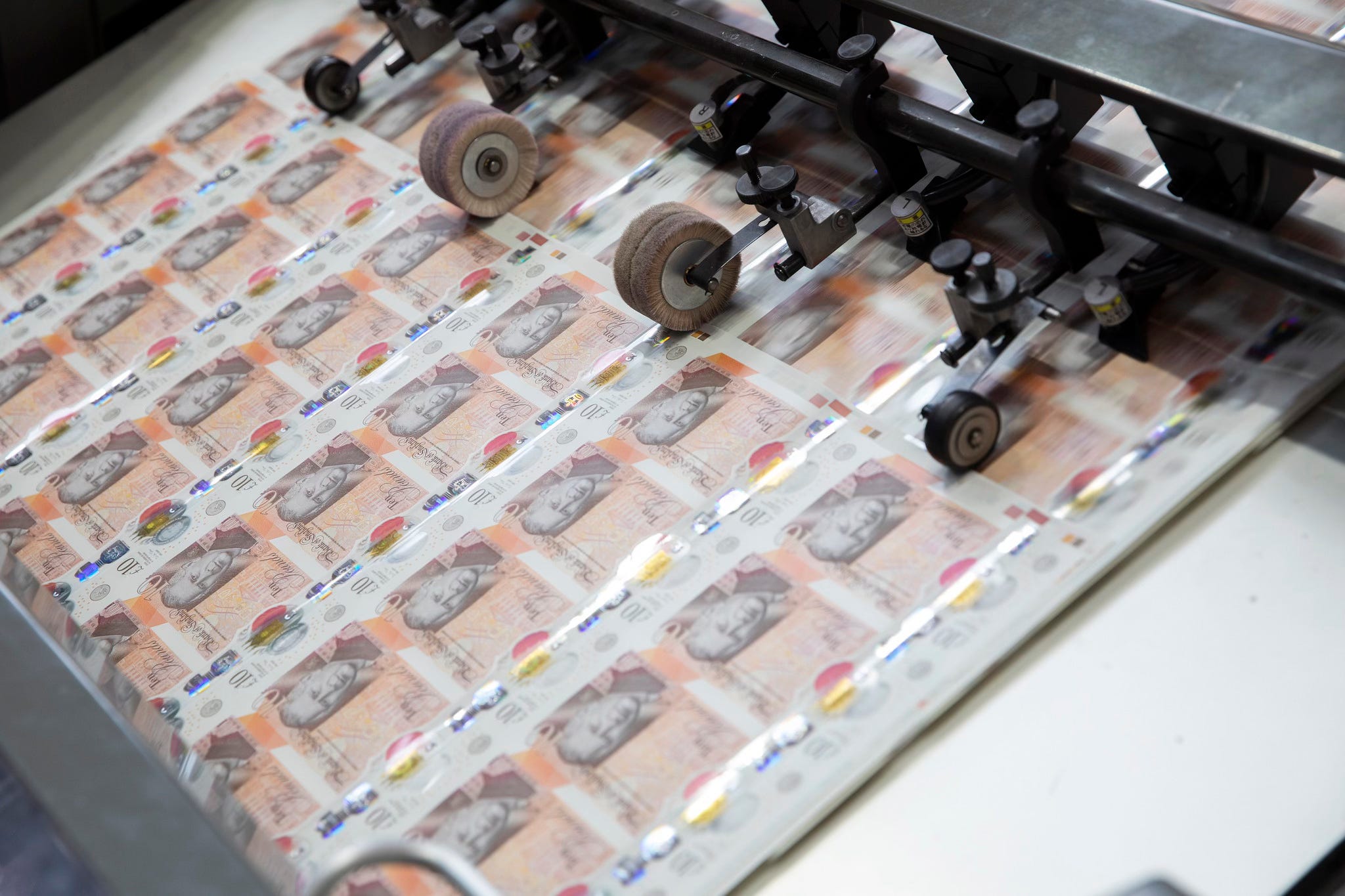
The iconography of banknotes has generated a whole new school of academic study. According to Michael Billig, professor emeritus of social psychology at Loughborough University, the style of the cash we must use seeks to “construct and reproduce specific nations and nation-states as indispensable cornerstones of international geopolitical order known as banal nationalism”.
Not surprisingly then the Bank of England’s announcement that it plans to redesign England and Wales’s folding stuff has generated much excitement. What’s more, the Bank wants the public’s views on which images to use on the £5, £10, £20, and £50 notes. The opinionated have until 11.59 pm on 31 July to enlighten Notes Directorate’s Banknote Imagery Consultation.
By chance, this offers a splendid opportunity to test the temperature of banal nationalism both at home and in the European superstate, because the European Central Bank has simultaneously launched a consultation over a new design for its Euro notes.
Inclusion of the King’s portrait is non-negotiable for the Bank of England. Otherwise, the Bank has thrown the choice wide open with a list of suggested themes including “nature, architecture and landmarks, arts, culture and sport (including food), noteworthy milestones” and “innovation”.
“Notable historical figures” also remain on list of approved topics. They have featured on the notes since 1970, starting with William Shakespeare on £20, ending, most recently, with Alan Turing on the £50. Sixteen great British males in all made the grade and three females – Florence Nightingale, Elizabeth Fry and Jane Austen plus the Italian educational pioneer Maria Montessori on the old £1 note.
Jacob Rees Mogg, that self-appointed guardian of tradition, smells a rat all the same. He warns that “The Bank of Wokeness wants to ignore our history and heroes to model itself on the unutterable banality of euro notes. It shows a lack of confidence in the nation and a supine kowtowing to the gods of political correctness.”
Conservative MP Kevin Hollinrake joined in the denunciation of “wrongheaded wokery” fearing that “replacing historical figures with abstract themes risks erasing the rich, complex story of how our country has evolved.”
Members of the public shared their dismay. “Let’s face it, we’re going to end up with Diane Abbott”, one tweeted. One social media poster produced a mocked-up note with an image of Larry the Downing Street Cat. Another offered an AI generated banknote featuring Margaret Thatcher. In practice, only Thatcher is a real possibility if the BoE sticks by its rules, which ban depictions of living individuals other than the King.
Royal Mail abandoned its own similar code long ago. To boost the sale of stamps, pop groups and TV personalities now feature regularly on special issues.
Mogg and his fellow Eurosceptics will be disappointed when they learn that the Eurozone is abandoning unspecific “banality” with confident plans for boastful new Euro notes.
The UK was still a member state back when the Euro launched in the year 2000. To avert rows and the bruised pride of individual nations, the commission went out of its way then to choose generic images of doorways and bridges for its debut banknotes, claiming they represented Europe’s architectural history, shared by all.
National symbols were left for the small change. Except in Holland where Queen Beatrix declared she would be happy to lose her head from coins in the spirit of Euro unity.
Another Dutch euro-fanatic constructed concrete versions over a canal of what he believed were the idealised notions of bridges on the banknotes. Much embarrassment followed when the original Austrian designer was exposed for copying specific pieces of architecture from around the world, not all of them even in Europe. A second artist, German this time, was called in to “refresh” the designs and make sure “they do not show any actual existing monuments or bridges”.
For its new notes, the EU is unashamedly mandating pictures of real things and people, what it considers to be the best that Europe has to offer.
The Governing Council of the European Central Bank has “selected” two possible motifs for a final decision by which the Eurocrats will take themselves. “The new banknotes will symbolise our shared European identity and the diversity that makes us strong”, ECB president Christine Lagarde has ruled.
The EU’s first motif of “shared cultural spaces” features titans from Europe’s founding and most powerful member states. €5, Maria Callas of Greece; €10, Beethoven of Germany; €20, Marie Curie of France, with a nod to Poland in her background; €50, Cervantes of Spain; €l00, Da Vinci of Italy.
Bertha von Suttner has been chosen for the €200. She was new to me. An aristocrat in the Austro-Hungarian empire she represents a nod towards the EU’s newer member states from the east. A pacifist and feminist, Suttner was the first recipient of the Nobel Peace Prize and private secretary to Alfred Nobel.
The ECB has discontinued the big denomination €500 note after it became the favourite currency of criminals, smugglers and drug dealers. The BoE has no plans for a £100 note or higher.
The reverse side of these EU hero notes will show inclusive scenes of human activity – a town square, a library, a choir, a school etc.
The ECB subtly reverses the stamp of European authority with its second proposed motif: “rivers and birds: resilience in diversity”.
At first glance, this is a less politically controversial option. Kingfishers, storks and gannets do not belong to any one country. Many countries outside Europe also use wildlife in their iconography.
Turn these pastoral notes over and Brussels is everywhere. Each note will be emblazoned with a picture of a major EU institution – the Parliament, the Commission, the Central Bank, the Court of Justice, the Auditors Office. Europeans will have to carry the images of these seats of power over them in their wallets. It is difficult to see the British public opting for the equivalent pictures of the Palace of Westminster, HM Treasury, 10 Downing St, the Old Bailey and the National Audit Office.
Andrew Bailey, the Governor of the Bank of England, and Victoria Cleland, his Chief Cashier who signs the notes and is the only woman to have held that job, are both primed to reject manifestations of the British sense of humour such as “Notey McNoteface”. Britain’s final choice will be very tricky enough without the jokes. Any selection of people, places or animals for the notes are likely to spark a culture war.
This week, YouGov tested public opinion on the banknote picture question. An estimated 20% want to stick with historical figures, never mind colonialism, warmongering and the patriarchy. Architecture scored 14%. Arts, sport, historic scenes and innovations are each low down in single figures.
The top preference is the most banal. Some 29% back “British natural landscape and/or wildlife”. The national mood is to dodge an argument if we can, even if that means falling into the EU’s old trap of meaningless generalisation.
Don’t make a fuss. ““Natural” Landscape” rules out man-made buildings, or cries of “what about Wales”. One waterfall or moorland looks much like another. This way there will be no need to soul-search about the pagan origins of Stonehenge? Or to ask what why there are no Scottish and Northern Irish images (Answer because their banks print their own notes. Kryponite to London cab drivers.)
When it comes to what we want to see on our banknotes, Britain is on course to favour banality and lack of conviction over national pride. Rightly or wrongly the leaders of the European Union are heading in the other direction, determined to assert the EU’s collective cultural identity.
